
Tipping culture in modern dining has become one of the most fiercely debated topics across social media platforms. Every week, photos of diner receipts go viral on platforms like Facebook, Reddit, and TikTok, triggering intense discussions between restaurant workers, patrons, industry experts, and consumer advocates. From auto-gratuity fees to written messages left on customer slips, these real-life dining moments highlight a growing cultural divide over tipping etiquette, service expectations, and workplace compensation.
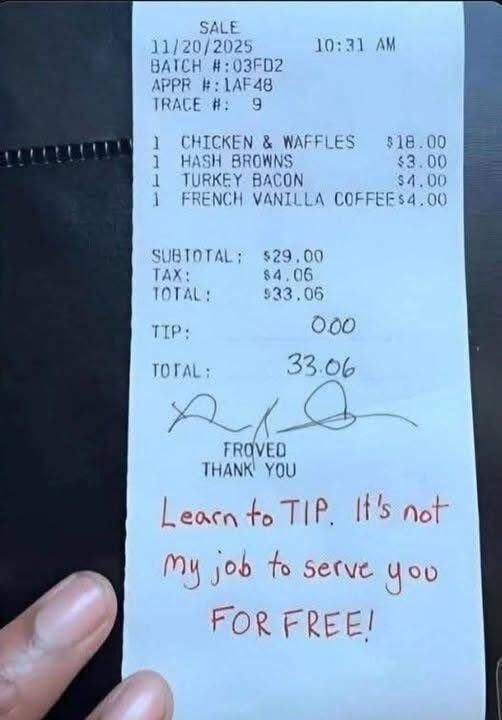
A viral receipt image currently making waves online shows a customer’s breakfast bill totaling $33.06 for chicken and waffles, hash browns, turkey bacon, and french vanilla coffee. After the customer left a $0.00 tip on the slip, a blunt message was handwritten across the bottom in red pen: “Learn to TIP. It’s not my job to serve you FOR FREE!”
In this deep dive, we will analyze the breakdown of this viral receipt, explore the underlying economic factors driving today’s tipping debates, compare international service standards, and discuss how managing personal finances and business operations can foster better experiences for everyone.
Deconstructing the Viral Receipt: The Breakdown
Understanding why this receipt generated such a passionate online response requires looking at both the transaction details and the emotional impact of the handwritten note.
The Itemized Bill
-
1 Chicken & Waffles: $18.00
-
1 Hash Browns: $3.00
-
1 Turkey Bacon: $4.00
-
1 French Vanilla Coffee: $4.00
-
Subtotal: $29.00
-
Tax: $4.06
-
Total Paid: $33.06
-
Tip Line: $0.00
The Reaction: Server Frustration vs. Customer Discontent
The handwritten message highlights a deep-seated frustration felt by many hospitality workers. In the United States, tipped minimum wage laws allow employers in many states to pay tipped staff significantly less than the standard hourly minimum wage, relying on customer tips to make up the difference. When a customer leaves a zero-dollar tip, the server feels that their labor and time went uncompensated.
On the other side of the debate, many consumers express growing “tip fatigue.” With tipping prompts expanding into fast-food counters, self-service kiosks, and online orders, customers often argue that baseline wages should be guaranteed by business owners rather than subsidized directly by diners.
The Economics of Modern Tipping Culture
The conflict seen on this receipt stems from fundamental structural differences in how the service industry operates compared to other economic sectors.
       +-------------------------------------------------------+
       |             THE DYNAMICS OF TIPPING WAGES             |
       +-------------------------------------------------------+
                                   |
              +--------------------+--------------------+
              |                                         |
              v                                         v
   +-----------------------+               +-----------------------+
   |   SERVER PERSPECTIVE  |               |  CUSTOMER PERSPECTIVE |
   +-----------------------+               +-----------------------+
   | * Lower base hourly   |               | * Expects clear menu  |
   |   wage from employer  |               |   pricing upfront     |
   | * Relies on 15-20%    |               | * Feels "tip fatigue" |
   |   tips for living income|             |   from widespread fees|
   +-----------------------+               +-----------------------+
              |                                         |
              +--------------------+--------------------+
                                   |
                                   v
                      +-------------------------+
                      |   DEBATED RESOLUTIONS   |
                      | (Higher base wages vs.  |
                      |  Traditional tipping)   |
                      +-------------------------+
The Tipped Wage Credit System
Under the U.S. Fair Labor Standards Act (FLSA), employers can claim a “tip credit,” paying a direct cash wage below the federal minimum wage as long as earned tips make up the difference. While employers are legally required to cover any shortfall, enforcement, tip pooling rules, and shifting shift volumes create income volatility for workers.
The Rise of “Tip Fatigue”
In recent years, point-of-sale digital screens have introduced pre-set tipping options across non-traditional venues. This expansion has led to widespread consumer pushback, making customers less inclined to leave customary tips even in traditional sit-down table service environments.
Comparing Global Dining and Service Expectations
Tipping customs vary significantly around the world. Here is a comparison of how different regions handle server compensation and dining etiquette.
| Country / Region | Tipping Expectation | Server Wage Model | Customer Experience |
| United States & Canada | 15% to 20%+ expected for sit-down dining | Lower base hourly wage relying heavily on tips | High-attentiveness service model |
| European Union | Service often included in bill (Service Compris) | Higher baseline hourly wages with benefits | Relaxed dining pace, modest rounding up |
| Japan & East Asia | Tipping is generally discouraged or offensive | Full professional salary paid directly by employer | High hospitality standards included in meal cost |
| Australia & New Zealand | Optional, modest tipping for exceptional service | Fair Work award minimum wages built into pricing | Straightforward, transparent menu pricing |
Financial Peace, Healthcare, and Business Management
The public debate over tipping highlights broader economic pressures facing both everyday households and business owners today. Achieving financial stability and reduced stress involves smart planning across multiple areas of life.
Supporting Service Workers with Healthcare and Benefits
Fluctuating income makes securing adequate healthcare coverage a top priority for service industry employees. Access to affordable health insurance, preventative medical care, and wellness resources ensures that hospitality workers maintain long-term physical health and financial security.
Business Management, Legal Compliance, and Transparency
For restaurant owners, maintaining transparent pricing structures and complying with labor laws creates a fair environment for both staff and patrons:
-
Legal Services and Employment Law: Proper legal guidance ensures businesses adhere strictly to minimum wage laws, tip credit compliance, and fair tip pooling distribution.
-
Financial and Operations Management: Securing low-interest business loans, managing commercial mortgages, maintaining property insurance, and optimizing accounting systems help owners balance payroll expenses with menu affordability.
-
Personal Financial Planning: Managing personal credit cards, auto loans, and emergency savings accounts builds a safety net against unpredictable economic shifts.
Practical Etiquette Tips for Navigating Modern Tipping
Whether you are dining out at a sit-down restaurant or grabbing a quick coffee, keep these practical tips in mind:
-
Know the Standard Guidelines: For traditional sit-down table service in North America, a 15% to 20% tip on the pre-tax subtotal remains the customary standard for good service.
-
Address Poor Service Directly: If you receive unsatisfactory service, speak directly with a manager rather than leaving a zero-dollar tip without explanation, as management can often resolve the issue or adjust your bill.
-
Check the Receipt for Auto-Gratuity: Always review your itemized bill to see if a service charge or auto-gratuity has already been included, especially for large groups.
-
Be Mindful of Cash vs. Card Tips: Cash tips are often preferred by servers because they are received immediately at the end of a shift, though card tipping remains widely convenient.
Fascinating Facts About Tipping History
-
Origin of the Word “Tip”: A popular urban legend claims “TIP” stands for “To Insure Promptness,” but language historians note that the word originated as 17th-century English slang meaning “to give or pass a small gift.”
-
Tipping Bans in American History: In the early 20th century, several U.S. states actually passed laws banning tipping, viewing the practice as un-American and anti-democratic, though all of these laws were repealed by the 1920s.
-
The First Modern No-Tip Restaurants: In recent years, a growing number of U.S. restaurants have experimented with “hospitality included” models, raising menu prices by 15-20% to pay kitchen and floor staff living wages with health benefits.
Conclusion
This viral receipt note serves as a stark reflection of the ongoing tension in modern dining culture. While servers rely on tips to earn a living wage under current legal frameworks, diners continue to navigate shifting expectations and menu prices.
By promoting open discussions around fair wages, business transparency, financial literacy, and quality healthcare access, both workers and consumers can work toward a more sustainable and positive dining experience. Share your thoughts on this viral debate with friends and family today!
Frequently Asked Questions (FAQ)
Q1: What happened in the viral receipt photo?
A customer paid $33.06 for breakfast but left a $0.00 tip. In response, the server wrote a note across the slip stating: “Learn to TIP. It’s not my job to serve you FOR FREE!”
Q2: What is the customary tip percentage for sit-down dining in North America?
The standard customary tip for sit-down table service is generally 15% to 20% of the pre-tax subtotal for good service.
Q3: What is the tipped minimum wage?
The tipped minimum wage allows employers to pay hospitality workers a base cash wage below the federal standard minimum wage, provided that customer tips bring the worker’s total earnings up to minimum wage requirements.
Q4: Should you tip on tax or subtotal?
Etiquette experts generally recommend calculating tips based on the pre-tax subtotal of the meal rather than the final total including state or local sales tax.
Q5: Is tipping expected in countries outside North America?
Tipping practices vary widely. In many European countries, a service charge is included in the bill or modest rounding up is common, while in countries like Japan, tipping is not customary.
