
Optical illusions, visual brain teasers, and personality quizzes have a unique way of capturing global attention across social media. From debated dress colors to hidden animals in lush landscapes, these engaging visual tests invite millions of users to compare notes, laugh at unexpected reveals, and debate what their initial perception says about their minds.
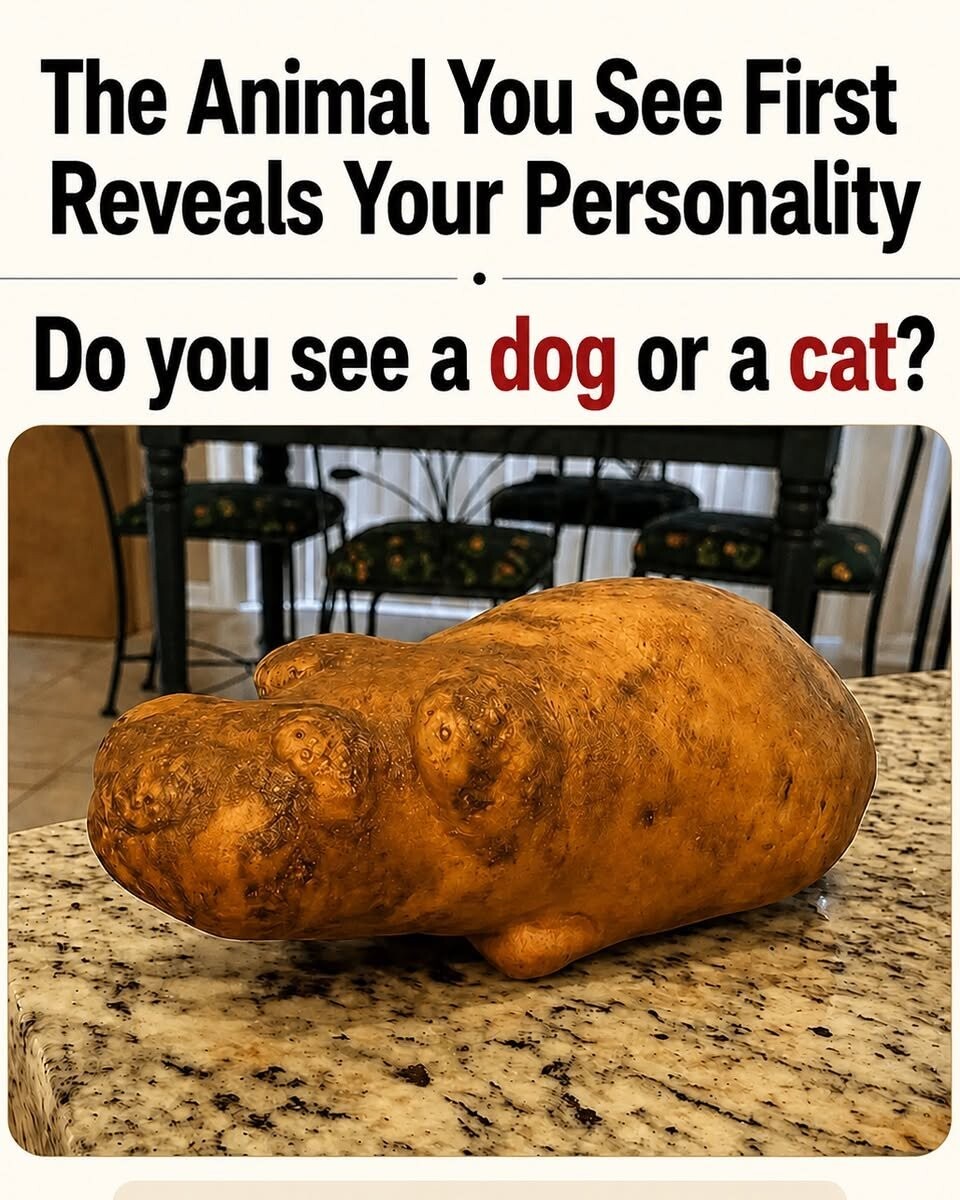
A recent viral image circulating online asks viewers a simple question: “The animal you see first reveals your personality: Do you see a dog or a cat?” The image presents a textured, brownish shape lying on a granite countertop in front of dining chairs. At first glance, the silhouette uncannily resembles a resting animal—perhaps a sleeping dog curled up on the counter or a resting cat with its paws tucked in. However, a closer look reveals a hilarious surprise: it isn’t an animal at all, but a uniquely shaped potato!
In this comprehensive guide, we will analyze why this potato optical illusion tricks the human eye, explore the cognitive psychology behind visual perception and pareidolia, examine popular personality archetypes often linked to visual tests, and discuss how maintaining holistic health supports long-term visual and cognitive agility.
Deconstructing the Illusion: Why Your Brain Sees an Animal
The human visual system is one of the most sophisticated processing networks in nature. However, it relies heavily on shortcuts and environmental assumptions to interpret complex visual data instantly.
The Role of Silhouette and Contour
When light enters the eye, the primary visual cortex rapidly processes edges, contrast, and overall shape before filling in fine details. The potato in the viral photograph features rounded, organic contours: a raised section on the left that resembles an animal’s head or snout, a central curved mass mimicking a torso, and small bumps along the bottom that look remarkably like resting paws.
Texture and Surface Color
The mottled brown skin of the potato creates natural shadows and highlights that mimic animal fur under indoor lighting. Combined with the granite countertop setting—a common spot for pets to lounge or seek attention—the environment primes the viewer’s brain to expect a household animal rather than produce.
The Science of Pareidolia and Top-Down Visual Processing
Why does the human brain continuously attempt to recognize familiar living forms in inanimate objects? This fascinating phenomenon is rooted in evolutionary biology and cognitive psychology.
       +-------------------------------------------------------+
       |             VISUAL ILLUSION PROCESSING FLOW           |
       +-------------------------------------------------------+
                                   |
                                   v
                      +-------------------------+
                      | RETINAL LIGHT CAPTURE   |
                      | (Organic Shape & Color) |
                      +-------------------------+
                                   |
                                   v
                      +-------------------------+
                      | PRIMING & EXPECTATION   |
                      | ("Do you see dog/cat?") |
                      +-------------------------+
                                   |
                                   v
               +-----------------------------------------+
               |                                         |
               v                                         v
    +--------------------+                     +--------------------+
    |   PAREIDOLIA TRIGGER|                    | SECONDARY ANALYSIS |
    | Brain fits shape   |                     | Eye inspects skin, |
    | to pet silhouette  |                     | spots root sprouts |
    +--------------------+                     +--------------------+
               |                                         |
               +--------------------+--------------------+
                                    |
                                    v
                       +------------------------+
                       | RECOGNITION: POTATO!   |
                       +------------------------+
1. Pareidolia and Evolutionary Survival
Pareidolia is the psychological tendency to perceive meaningful images—especially animal forms or human faces—in random visual patterns. From an evolutionary perspective, early humans who quickly recognized hidden predators or allies in tall grass or shadowy rocks were more likely to survive. Today, that same survival mechanism leads us to spot animal shapes in clouds, tree bark, and oddly shaped vegetables.
2. Cognitive Priming
The text at the top of the image plays a critical role in framing perception. By asking “Do you see a dog or a cat?”, the caption uses a psychological technique known as priming. Priming pre-activates specific concepts in your mental lexicon, forcing the brain to evaluate the image through a binary choice (dog vs. cat) before considering alternative options like a potato.
Comparing Dog People vs. Cat People Personality Traits
While this specific viral test is a humorous trick, popular psychology frequently explores how preferences for dogs or cats reflect distinct personality traits and behavioral tendencies.
| Trait / Characteristic | “Dog People” Traits | “Cat People” Traits |
| Social Orientation | Highly extroverted, outgoing, and energetic | Introverted, reserved, and introspective |
| Work Preference | Collaborative, team-oriented, and open | Independent, self-directed, and autonomous |
| Rule Adherence | Traditional, rule-following, and agreeable | Unconventional, curious, and open-minded |
| Environment | Thrives in active, social, and busy settings | Prefers quiet, cozy, and relaxed environments |
| Decision-Making | Driven by social connection and enthusiasm | Driven by logic, observation, and intuition |
Supporting Cognitive Agility, Eye Health, and Overall Wellness
Engaging with brain teasers, visual puzzles, and humorous optical illusions provides a great mental workout. However, maintaining sharp visual perception and cognitive vitality requires a well-rounded approach to physical and mental health.
Protecting Vision and Eye Health
Visual processing relies on healthy eyes. Prolonged screen time can lead to digital eye strain, dryness, and fatigue. Practicing the 20-20-20 rule (looking at an object 20 feet away for 20 seconds every 20 minutes), getting annual eye examinations, and maintaining proper hydration keep your eyes performing at their best.
Managing Systemic Health and Healthcare Coverage
Visual acuity and neurological health are closely tied to systemic well-being. Conditions such as diabetes, high blood pressure, and vascular changes directly impact eye health. Maintaining comprehensive health insurance ensures access to regular routine physicals, vision tests, and preventative care without unexpected financial burdens.
Financial Peace, Reduced Stress, and Life Stability
Chronic stress elevates cortisol levels, which can negatively affect focus, memory, and cognitive processing speed. Achieving mental peace of mind comes down to keeping daily responsibilities organized:
-
Financial Management: Securing low-interest personal loans, managing mortgage payments responsibly, consolidating credit debt, and seeking professional financial advice eliminate constant financial worry.
-
Legal and Business Protection: Organizing estate plans, legal services, home insurance, and business operations protects family wealth for future generations.
-
Balanced Lifestyle: Dedicating time to nutritious whole foods, regular physical exercise, quality sleep, and laughter with friends lowers stress and supports overall health.
Practical Tips for Sharpening Your Visual Observation Skills
Want to improve your eye for detail and avoid getting fooled by optical illusions? Apply these simple visual scanning techniques:
-
Zoom In on Texture: Look closely at surface details. Synthetic or vegetable surfaces have uniform skin patterns, root eyes, or smooth textures distinct from animal fur.
-
Analyze Lighting and Shadows: Check whether light reflections and shadows align with 3D animal contours or indicate a flat, dense object lying on a surface.
-
Read Beyond the Caption: When presented with a prompt asking you to choose between two options, pause and ask: “What else could this object be?”
-
Change Your Viewing Angle: Step back from your screen or tilt your phone slightly to break the initial visual illusion and view the object as a neutral geometric form.
Fun Facts About Potatoes and Visual Perception
-
Infinite Shapes: Potatoes are extremely prone to growing into unusual, organic shapes due to uneven soil pressure, moisture variations, and root growth paths, often producing uncanny resemblances to animals, hearts, or human faces.
-
The First Space Vegetable: In 1995, potato plants were taken into space aboard the Space Shuttle Columbia, becoming the very first vegetable grown in zero gravity!
-
Fast Processing Speed: The human brain can recognize an object or face in a visual scene in as little as 13 milliseconds, long before we consciously articulate what we are looking at.
Conclusion
Visual illusions like this viral potato test remind us of how playful, complex, and adaptable human perception can be. Whether you initially saw a sleeping dog, a curled-up cat, or immediately spotted the humble potato, taking a moment to engage with visual brain teasers provides a fun and satisfying mental break.
By pairing cognitive exercises with physical health care, eye protection, balanced stress management, and sound financial planning, you can support your visual acuity and overall quality of life. Share this hilarious illusion with friends and family today to see who gets fooled first!
Frequently Asked Questions (FAQ)
Q1: What is actually shown in the viral photo?
Despite looking like a sleeping dog or cat at first glance, the object in the photo is actually a unusually shaped potato sitting on a granite countertop.
Q2: What causes pareidolia in the human brain?
Pareidolia is an evolutionary visual trait where the brain rapidly processes light, contrast, and shapes to find recognizable patterns—such as faces or animals—in random objects.
Q3: Why did the caption ask if I see a dog or a cat?
The caption uses psychological priming to focus your brain on choosing between two animal options, making the ultimate potato reveal much funnier and more surprising.
Q4: How can I reduce digital eye strain when viewing visual puzzles on screens?
Reduce eye strain by taking regular breaks using the 20-20-20 rule, adjusting screen brightness to match room lighting, and keeping your eyes hydrated with lubricating eye drops if needed.
Q5: Can visual puzzles improve brain function?
Yes! Visual puzzles and cognitive challenges stimulate pattern recognition, visual-spatial processing, and focus, helping keep your cognitive pathways active and flexible.
