
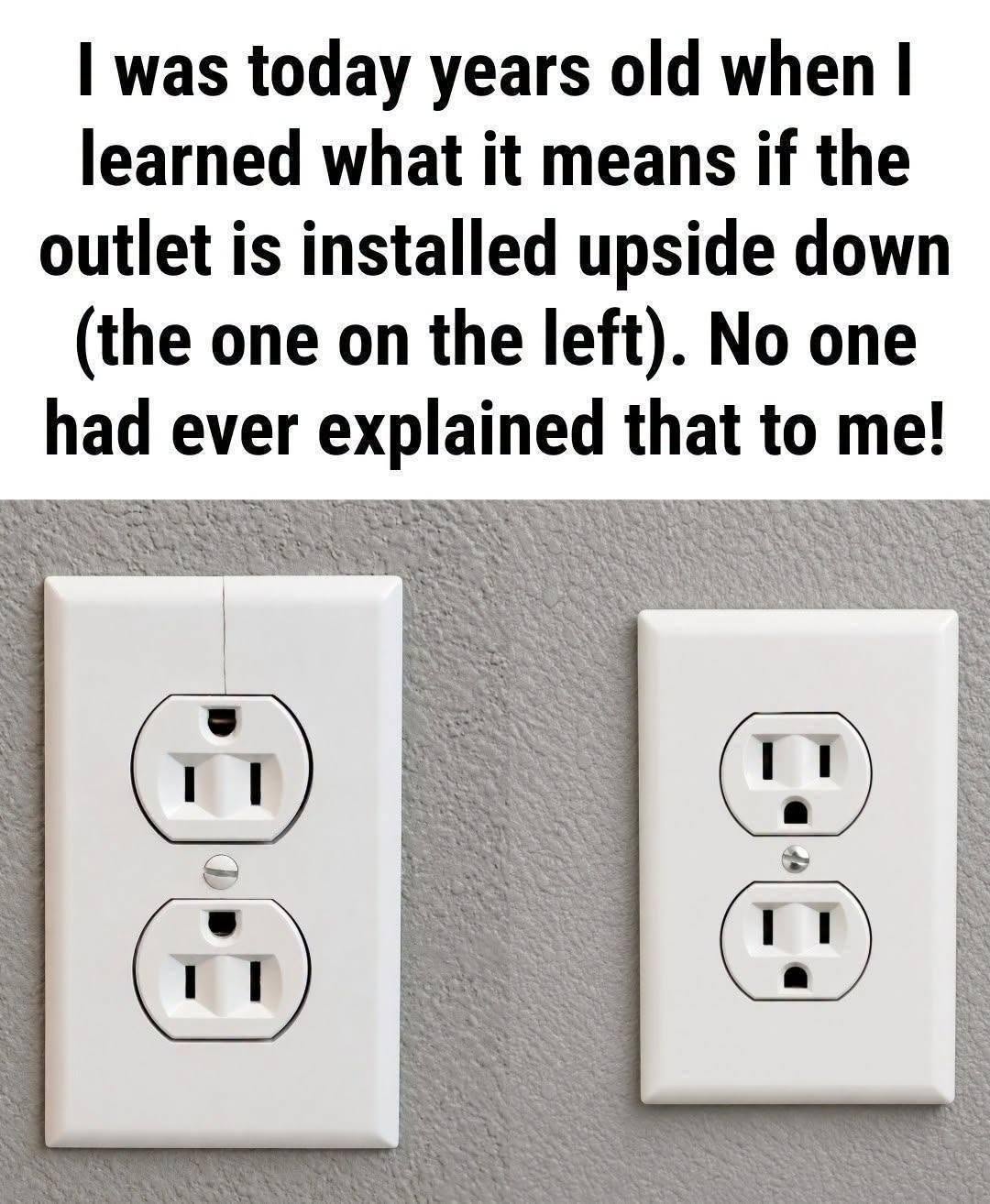
When walking through a newly built house, an apartment building, or a renovated office space, you might occasionally spot an electrical wall receptacle that looks completely inverted. While standard North American outlets feature two vertical slots on top with a D-shaped grounding hole at the bottom (resembling a smiling face), an inverted outlet positions the rounded ground pin hole at the top. Most homeowners assume an upside-down outlet is simply the result of a careless mistake or an amateur electrical installation.
However, in professional electrical contracting and building construction, an upside-down outlet is almost always installed that way for very deliberate safety and functional reasons. Understanding why electricians invert wall receptacles reveals critical insights into home safety standards, electrical code practices, and smart energy management.
The Primary Reasons for Upside-Down Outlet Installation
Electricians turn receptacles upside down (ground pin facing up) for two primary reasons: enhanced electrical safety and clear identification of switched outlets.
+-------------------------------------------------------------------------------+
|                    OUTLET ORIENTATION COMPARISON MATRIX                       |
+--------------------------+-------------------------+--------------------------+
| FEATURE                  | GROUND PIN UP (LEFT)    | GROUND PIN DOWN (RIGHT)  |
+--------------------------+-------------------------+--------------------------+
| Primary Safety Benefit   | Prevents short circuits | Standard visual look     |
| Common Application       | Switched outlets & commercial| General residential  |
| Metal Object Drop Risk   | Hits ground pin safely  | Hits energized hot prong |
| NEC Code Requirement     | Allowed & recommended   | Standard convention      |
+--------------------------+-------------------------+--------------------------+
1. Enhanced Electrical Safety and Short Circuit Prevention
The most critical engineering reason to position the ground pin at the top is physical safety.
When an electrical cord plug is inserted into a wall receptacle, it can sometimes slip slightly out of the socket, leaving the metal prongs partially exposed. If a thin conductive object—such as a falling metal picture frame, paperclip, metal ruler, or butter knife—slides down the wall between the plug and the wall plate:
-
Ground Pin Down Position: The falling metal object will strike both energized “hot” and “neutral” prongs simultaneously. This immediately triggers a dangerous electrical arc spark, causes a short circuit, blows a circuit breaker, or creates an immediate fire hazard.
-
Ground Pin Up Position: The falling metal object lands safely on the solid metal grounding pin first. Because the ground pin carries no electric current, the object is deflected safely away from the live hot and neutral prongs underneath, preventing sparks and electrical fires.
2. Identifying Switched Outlets in Residential Homes
In modern home construction, electricians frequently install upside-down outlets to signal a specific functional feature: a wall switch connection.
-
Half-Hot Outlets: Builders often wire one half of a duplex receptacle to a wall switch (for floor lamps) while keeping the other half continuously powered. Turning the entire socket or half of it upside down serves as a subtle visual indicator to homeowners that the outlet is controlled by a nearby light switch.
-
Commercial and Hospital Standards: Many commercial facilities, medical buildings, and school systems mandate ground-up installations across all wall receptacles to comply with institutional safety regulations.
National Electrical Code (NEC) Standards: Is There a “Right” Way?
A common point of confusion among homeowners is whether local building codes mandate one orientation over another.
The National Electrical Code (NEC)—the standardized benchmark for safe electrical design and installation across North America—does not specify whether a ground pin must point up or down. Both orientations are fully compliant with national safety codes. However, several specialized codes, such as healthcare facility standards (NFPA 99), explicitly recommend or require ground-up orientation for enhanced safety in patient rooms and high-risk environments.
Home Insurance, Legal, and Electrical Maintenance Considerations
Understanding your home’s electrical wiring standards is not just about convenience; it carries major implications for property safety, home insurance compliance, and home maintenance.
Fire Risk Reduction and Property Insurance Claims
Electrical fires remain one of the leading causes of residential property damage. Maintaining modern, properly installed electrical receptacles reduces fire risks, protecting your household and preventing disputed property insurance claims. Insurance adjusters and municipal home inspectors look closely at electrical panel safety, Ground Fault Circuit Interrupter (GFCI) installation, and proper wiring connections during home evaluations.
Preserving Appliance Integrity and Preventing Outages
Short circuits caused by slipping plugs can send power surges through home electrical circuits, potentially damaging sensitive electronics like computers, televisions, and high-end audio systems. Ground-up installations add a layer of passive physical protection that preserves appliance longevity and saves homeowners from costly electrical repairs.
Practical Electrical Safety Tips for Every Homeowner
-
Test Switched Outlets: If you find a single upside-down outlet in your living room or bedroom, plug a lamp into it and test nearby wall switches—it is likely linked to a wall switch designed for secondary lighting.
-
Upgrade to GFCI and AFCI Outlets: Ensure kitchen countertops, bathrooms, outdoor areas, and garages are equipped with Ground Fault Circuit Interrupter (GFCI) outlets to protect against water-related shock hazards.
-
Replace Loose Wall Outlets: If plugs fall out or feel loose when plugged into a wall socket, the internal metal contact tension has degraded. Have a licensed electrician replace worn receptacles immediately to prevent arcing and overheating.
-
Never Cut Off the Ground Pin: Grounding pins provide a safe emergency pathway for excess electrical current during a surge or fault. Never remove the third prong from a plug to fit a two-slot extension cord.
Fascinating Facts About Electrical Systems
-
The Third Pin Evolution: Early American home outlets featured only two slots (hot and neutral). The rounded ground pin was introduced in the mid-20th century to protect users from severe electrical shocks when operating metal-cased appliances.
-
Global Plug Diversity: There are 15 distinct types of domestic electrical outlet plugs used worldwide today, labeled by the US Department of Commerce from Type A to Type O.
-
Why Outlets Look Like Faces: The layout of standard Type B North American outlets mimics a human face purely by mechanical accident: the two eyes are the hot and neutral contact wipers, and the mouth is the ground pin chamber.
Conclusion
An upside-down outlet is not a builder’s mistake or a sign of sloppy workmanship. Whether inverted to protect against accidental short circuits caused by falling metal objects or positioned to signal a wall-switch connection, ground-up outlets represent a deliberate, safety-minded installation choice. Recognizing these subtle engineering details helps homeowners maintain a safer, more efficient home environment.
Frequently Asked Questions (FAQ)
Is an upside-down outlet dangerous?
No. An upside-down outlet (ground pin facing up) is completely safe and actually offers superior protection against accidental short circuits caused by falling metallic objects compared to standard ground-down installations.
Why is only one outlet upside down in my room?
In most residential homes, a single upside-down outlet indicates that the socket is connected to a wall switch. Electricians turn it upside down so homeowners can easily identify which outlet controls floor lamps or accent lighting.
Can I flip an outlet upside down myself?
If you are comfortable working with residential electrical systems, you can turn off the main circuit breaker, verify the power is off using a voltage tester, unscrew the receptacle, rotate it 180 degrees, and re-mount it. However, if you are unsure, always hire a licensed electrician.
Which way does the National Electrical Code (NEC) require outlets to be installed?
The NEC permits both ground-up and ground-down installations. Neither direction violates national code, allowing electricians to choose the orientation best suited for the installation environment.
