
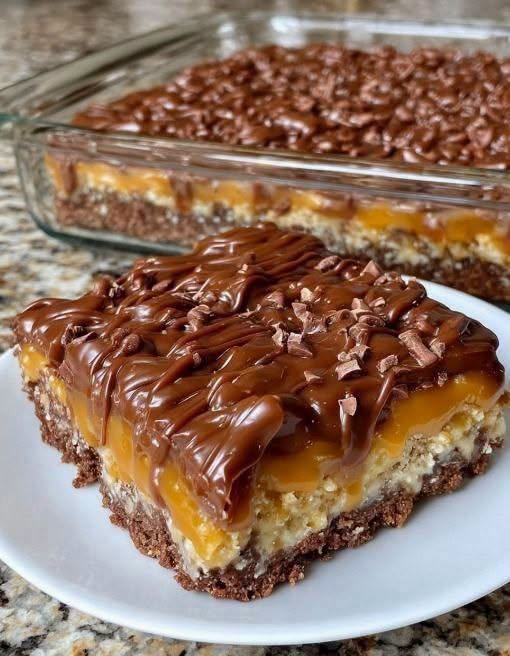
Few dessert combinations evoke as much pure satisfaction as the rich, harmonious pairing of dark chocolate, silky golden caramel, and toasted shredded coconut. Known in baking circles as Samoa bars, millionaires’ shortbread variations, or chocolate caramel coconut squares, these layered dessert bars are a crowd-pleasing classic for holidays, family gatherings, potlucks, and artisanal bakeries.
When you look at a freshly cut square resting on a plate—featuring a crunchy cocoa graham base, a chewy coconut filling, a thick layer of gooey caramel, and a decadent drizzle of smooth fudge topped with chocolate flakes—you are seeing a masterpiece of textural contrast and flavor balance. In this comprehensive guide, we explore the culinary science behind baking layered dessert bars, provide a step-by-step master recipe, share expert troubleshooting tips, analyze household dessert budgeting, and discuss commercial bakery management and trade standards.
The Food Chemistry of Layered Desserts: Achieving the Perfect Bite
Creating a multi-layered dessert bar requires careful attention to moisture control, structural integrity, and temperature management. Each layer serves a specific culinary function:
1. The Base: Chocolate Graham or Shortbread Crust
The bottom layer acts as the structural foundation for the entire bar. Combining finely crushed cocoa graham crackers or chocolate shortbread crumbs with melted unsalted butter creates a firm matrix. Pre-baking this crust for 8 to 10 minutes sets the starches, preventing it from turning soggy when liquid fillings are added on top.
2. The Middle Layer: Chewy Sweetened Coconut
Sweetened shredded coconut or desiccated coconut provides a distinct tropical aroma and satisfying chew. Binding the coconut with sweetened condensed milk ensures that the layer sets into a soft, cohesive filling rather than crumbling apart when sliced.
3. The Caramel Layer: Viscosity and Maillard Reaction
Caramelization occurs when simple sugars are heated, causing thermal decomposition that creates rich, buttery, complex flavor compounds. To achieve a soft caramel layer that holds its shape at room temperature without oozing everywhere or setting rock-hard, butter, heavy cream, and corn syrup are cooked to precise temperatures ($234^\circ\text{F}\text{ to }240^\circ\text{F}$ / $112^\circ\text{C}\text{ to }115^\circ\text{C}$—the soft-ball stage).
4. The Top Layer: Tempered Chocolate Fudge Drizzle and Flakes
Finishing the bar with a drizzle of rich chocolate fudge ganache and mini chocolate flakes introduces a delightful visual contrast and a rich cocoa bite that balances the sweetness of the caramel and coconut.
Step-by-Step Master Recipe: Chocolate Caramel Coconut Bars
This foolproof recipe yields 16 decadent squares using standard 9×13-inch glass or metal baking dishes.
Ingredients Needed
-
For the Cocoa Crust:
-
2 cups chocolate graham cracker crumbs (or crushed chocolate wafer cookies)
-
1/2 cup unsalted butter, melted
-
1/4 cup granulated sugar
-
1/4 teaspoon fine sea salt
-
-
For the Coconut Layer:
-
3 cups sweetened shredded coconut
-
1 cup sweetened condensed milk
-
1 teaspoon pure vanilla extract
-
-
For the Soft Caramel Layer:
-
11 oz soft caramel candies (unwrapped) or homemade caramel sauce
-
3 tablespoons heavy whipping cream
-
Pinch of sea salt
-
-
For the Chocolate Topping & Garnish:
-
1 cup semi-sweet or dark chocolate chips
-
2 tablespoons unsalted butter or heavy cream
-
2 tablespoons shaved chocolate flakes or cocoa nibs for topping
-
Step 1: Preparing the Crust
-
Preheat your oven to $350^\circ\text{F}$ ($175^\circ\text{C}$). Line a 9×13-inch baking dish with parchment paper, leaving an overhang on the sides for easy removal later.
-
In a medium bowl, combine the chocolate graham cracker crumbs, melted butter, granulated sugar, and salt until the mixture resembles wet sand.
-
Press the mixture firmly and evenly into the bottom of the prepared pan using the flat bottom of a measuring cup.
-
Bake for 8 to 10 minutes to set. Remove from the oven and let cool slightly.
Step 2: Adding and Baking the Coconut Layer
-
In a separate bowl, mix the sweetened shredded coconut, sweetened condensed milk, and vanilla extract until thoroughly combined.
-
Spread the coconut mixture evenly over the warm chocolate crust.
-
Return the dish to the oven and bake for 12 to 15 minutes until the edges are lightly golden and the layer is set. Allow the pan to cool completely on a wire rack.
Step 3: Preparing and Layering the Caramel
-
In a small saucepan over low heat (or in a microwave-safe bowl in 30-second bursts), combine the unwrapped caramels and heavy whipping cream. Stir continuously until completely smooth and melted.
-
Pour the warm caramel evenly over the cooled coconut layer, smoothing it out with an offset spatula.
Step 4: Chocolate Drizzle and Finishing Touch
-
Melt the chocolate chips with butter or heavy cream over a double boiler or in short microwave bursts until glossy and smooth.
-
Drizzle the warm melted chocolate generously back and forth across the caramel layer using a fork or piping bag to create an elegant zig-zag pattern.
-
Sprinkle shaved chocolate flakes or cocoa nibs over the top for added texture.
-
Chill the baking pan in the refrigerator for at least 2 hours until the caramel and chocolate layers are completely firm before slicing.
Nutritional Breakdown and Energy Considerations
Layered dessert bars are rich, indulgent treats that provide immediate caloric energy from carbohydrates and fats.
| Component | Nutritional Value per Serving (Approx. 1 Bar) | Primary Biological Function |
| Calories | $\sim 320\text{ kcal}$ | Total metabolic energy yield |
| Carbohydrates | $38\text{ g}$ | Quick glucose supply for cerebral & muscular energy |
| Dietary Fiber | $2.5\text{ g}$ (from coconut & dark cocoa) | Aids digestive transit time |
| Saturated & Monounsaturated Fats | $18\text{ g}$ (from coconut, butter, & cocoa butter) | Sustained energy & fat-soluble nutrient delivery |
| Magnesium & Copper | Trace amounts (from dark cocoa) | Mineral support for enzymatic function |
Expert Baking Hacks for Slicing and Storing
Achieving clean, picture-perfect square cuts without squishing the soft caramel or crumbling the crust requires proper technique:
-
Use the Parchment Sling: Use the parchment paper overhang to lift the entire chilled block out of the baking dish onto a large cutting board before slicing.
-
Warm Your Knife Blade: Run a large chef’s knife under hot tap water for 10 seconds, wipe it completely dry with a towel, and make one clean downward cut. Wipe and re-warm the blade between every single slice!
-
Storage Guidelines:
-
Room Temperature: Store in an airtight container between parchment sheets for up to 3 days in a cool room.
-
Refrigerator: Keeps exceptionally firm and fresh for up to 2 weeks.
-
Freezer: Wrap individual bars tightly in plastic wrap and foil; freeze for up to 3 months. Thaw in the fridge overnight before serving.
-
Financial Efficiency: Homemade Baking vs. Store-Bought Pastries
Preparing specialty dessert bars at home provides substantial financial savings compared to purchasing gourmet bakery products.
High Yield and Low Ingredient Costs
Artisanal bakeries often charge $4.00 to $6.00 per individual bar for multi-layered caramel coconut treats. Purchasing baking staples—such as graham crackers, condensed milk, shredded coconut, chocolate, and caramels—in bulk allows home bakers to produce an entire 16-bar tray for under $10.00, yielding massive savings for family budget management.
Strategic Allocation of Household Finances
Trimming spending on frequent café visits and commercial bakery impulse buys frees up disposable household capital. Reallocating consistent savings toward high-yield savings accounts, emergency funds, or retirement investments builds long-term wealth.
Commercial Bakeries, Food Safety, and Legal Standards
For entrepreneurs launching a home bakery, dessert catering business, or commercial pastry enterprise, key regulatory and legal standards apply:
Food Safety and Allergen Compliance
Coconut (classified by the FDA as a tree nut for labeling purposes), dairy, and gluten are major dietary allergens. Commercial food producers must explicitly disclose potential allergen exposure under the Food Allergen Labeling and Consumer Protection Act (FALCPA).
Cottage Food Laws and Business Protection
Small-batch home bakers selling desserts at local farmers’ markets or online must comply with local cottage food regulations regarding non-perishable baked goods. Consulting an experienced business attorney ensures proper LLC formation, commercial general liability insurance, food handler safety certifications, and accurate nutritional labeling.
Fascinating Culinary Facts About Chocolate, Caramel, and Coconut
-
The Origin of the Samoa: The famous Girl Scout “Samoa” (or Caramel deLites) cookie—which inspired this layered bar recipe—was first introduced in 1975 and remains the second most popular Girl Scout cookie flavor in America!
-
The Physics of Chocolate Tempering: Dark chocolate contains six distinct crystal forms ($\text{Form I}\text{ through }\text{Form VI}$). Proper tempering aligns the cocoa butter into stable $\text{Form V}$ crystals, giving finished dessert drizzles a glossy finish and crisp snap.
-
The Coconut Palm’s Yield: A single mature coconut palm tree (Cocos nucifera) can produce between 50 and 75 mature coconuts per year, providing coconut meat, water, milk, and oil across tropical regions.
Conclusion
These chocolate caramel coconut bars are the ultimate layered dessert—combining a crunchy cocoa crust, chewy coconut, buttery caramel, and a decadent fudge drizzle into every single bite. By following proper temperature controls, pre-baking the crust, and chilling the pan before slicing, you can recreate these bakery-quality squares in your own kitchen. Bake a batch for your next gathering or weekend treat and enjoy a truly unforgettable dessert!
Frequently Asked Questions (FAQ)
1. Can I use sweetened coconut instead of unsweetened coconut?
Yes! Sweetened shredded coconut yields a moister, chewier filling, while unsweetened desiccated coconut creates a slightly firmer texture with less overall sugar sweetness.
2. Why did my caramel layer turn out too hard or sticky?
If caramel is heated to too high a temperature, it loses excess water and sets hard. Always melt caramels over gentle, low heat with a few tablespoons of heavy cream to ensure a soft, sliceable caramel layer.
3. How do I keep the chocolate drizzle from melting in warm weather?
Use dark chocolate melted with a small amount of unsalted butter or heavy cream, and keep the sliced bars stored in the refrigerator until 15 minutes before serving.
4. Can I make these bars gluten-free?
Absolutly! Simply replace standard chocolate graham cracker crumbs with gluten-free chocolate cookie crumbs or gluten-free graham cracker crumbs for the base crust.
5. How long do these dessert bars last in the freezer?
When wrapped tightly in parchment paper and stored inside a heavy-duty freezer bag, these bars freeze beautifully for up to 3 months without losing flavor or texture.
