
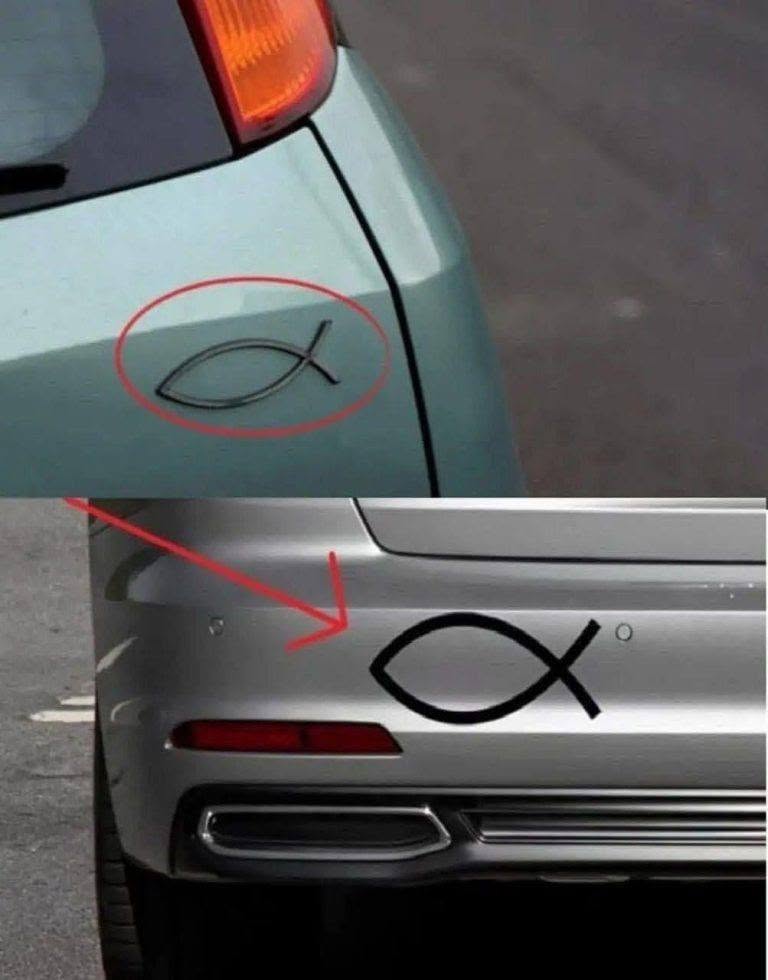
Driving down the road, you have almost certainly noticed a simple, outline-style fish symbol attached to the trunk lid or rear bumper of a car. Made of two intersecting arcs that extend beyond their meeting point to form a tail, this subtle emblem—often called the “Jesus fish” or Ichthys—is one of the most widespread auto accessories on highways around the world.
While millions of drivers see this iconic symbol every day during their morning commute, few know its true origin story. Far from being a modern trend created by car accessory manufacturers, the fish symbol carries a rich, secret history spanning over two thousand years. Here is a deep dive into what the fish symbol actually stands for, how it originated as a secret code, and why it remains so popular on vehicles today.
The Secret Origin: A Code for Survival in Ancient Times
To understand why a fish symbol became a widespread emblem, we have to look back to the 1st century AD during the early years of the Roman Empire.
During this era, practicing Christianity was outlawed by Roman authorities, leaving early believers exposed to severe persecution, imprisonment, and social exile. Because openly declaring one’s faith was dangerous, early Christians needed a covert way to identify fellow believers without tipping off Roman soldiers.
The Secret Handshake of Symbols
According to historical records, believers used the fish outline as a secret code:
-
The First Line: When meeting a stranger on the road, one person would draw a single curved arc in the sand with their foot or staff.
-
The Second Line: If the other person was also a believer, they would draw the opposing arc, completing the fish shape and silently confirming their shared identity without speaking a single word.
What Does ‘Ichthys’ Actually Mean?
The fish symbol is not just a visual drawing; it is a famous ancient acrostic—a word formed from the first letters of other words.
In ancient Greek, the word for fish is IXΘYΣ (pronounced IKH-THOOS or Ichthys). Early believers realized that each Greek letter in the word “fish” stood for a core theological phrase:
-
I – Iēsoûs (Jesus)
-
X – Khristós (Christ)
-
Θ – Theoû (God’s)
-
Y – Yiós (Son)
-
Σ – Sōtēr (Savior)
Together, the phrase read: “Jesus Christ, Son of God, Savior.” This clever Greek acronym allowed early communities to summarize their core beliefs in a single, easily drawn symbol.
From Ancient Rome to Modern Cars: The Bumper Emblem Boom
For centuries, the fish symbol remained primarily an ancient historical artifact featured in early subterranean catacombs, historic art, and ancient Mediterranean ruins. So how did it end up on modern vehicles?
During the 1970s, the “Jesus movement” and a wave of Christian revivalism swept across North America and Western Europe. Modern believers resurrected the ancient Ichthys symbol as a subtle, non-verbal way to express faith and community on personal property. Plastic and chrome-plated adhesive emblems were produced for car trunks, bumpers, and tailgates, allowing drivers to display their beliefs during daily travel.
Navigating daily commuting, auto upkeep, and personal vehicle customization intersects with broader everyday responsibilities, including maintaining reliable auto insurance, managing family travel, and planning routine vehicular maintenance.
Variations and Modern Pop-Culture Parodies
Over the decades, the widespread popularity of the Jesus fish on cars inspired various creative adaptations and humorous parodies across modern pop culture:
-
The Darwin Fish: Featuring small walking feet growing out of the fish body, this parody symbol was created to represent evolutionary science and secular humanism.
-
The “Gefilte” or “Kosher” Fish: Styled with distinct lettering inside the fish outline, this variation celebrates Jewish cultural pride.
-
The Flying Spaghetti Monster: A parody featuring tentacles coming out of the traditional outline, representing the satire movement known as Pastafarianism.
Frequently Asked Questions (FAQ)
What is the official name of the fish symbol seen on cars?
The symbol is technically known as the Ichthys (or Ichtus), which is the ancient Greek word for “fish.” Today, it is commonly referred to as the “Jesus fish.”
Why are fish associated with early history?
Beyond the secret Greek acronym, fish play a prominent role in early historical literature and gospel accounts, such as the famous story of feeding five thousand people with loaves and fish, as well as calling fishermen to become leaders.
Is the fish emblem safe to apply to car paint?
Yes. Modern auto emblems use automotive-grade double-sided acrylic foam tape that adheres securely to clear coat surfaces without causing damage. When removing them, applying mild heat from a hair dryer safely softens the adhesive glue.
Conclusion: A Simple Symbol with Two Millennia of History
The next time you pull up behind a car featuring a simple fish emblem on its trunk, you are looking at a historical tradition that spans more than two thousand years. What started as a hidden line drawn in the dirt to protect lives during ancient Roman rule has evolved into a global symbol of community and faith on modern highways. Simple, timeless, and rich with history, the Ichthys remains one of the most recognizable auto emblems on the road today.
Scroll down to explore more related articles.
