
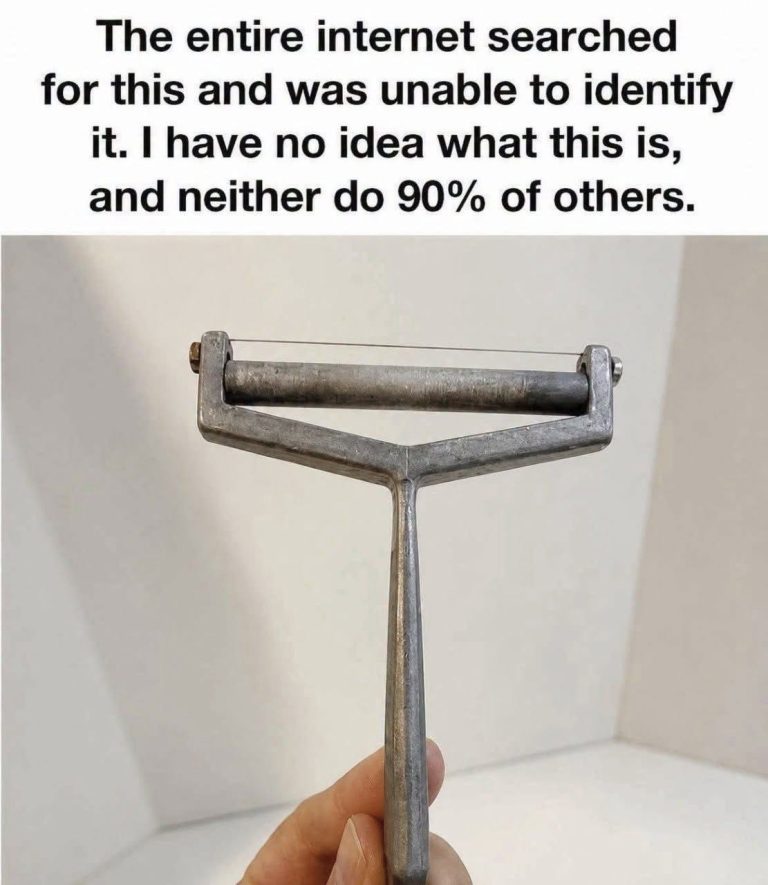
Every so often, an image of an obscure vintage tool or antique household object circulates across social media, sparking viral debates among thousands of curious onlookers. Featuring a cast-metal handle, a rotating roller bar, and a taut, thin stainless steel wire suspended across a frame, this specific vintage tool often stumped online sleuths who mistook it for a paint roller, clay cutter, or leather working tool.
In reality, this classic implement is an iconic piece of mid-century kitchen engineering: a roller-style wire cheese slicer (or handheld wire cheese cutter).
While modern kitchens rely on electric food processors, mandolines, or pre-packaged dairy products, older generations valued simple, mechanical tools that made food preparation clean, consistent, and effortless. Understanding how vintage wire slicers work—and why they remain superior to traditional knives for certain tasks—reveals fascinating insights into kitchen tool history, culinary technique, and food prep economics.
In this ultimate kitchen guide, we solve the mystery behind this vintage tool, explain the mechanics of wire slicing, compare different cheese cutting tools, share maintenance protocols, and explore how smart home culinary practices save you money on grocery expenses.
The Mystery Solved: How a Wire Roller Cheese Slicer Works
The tool featured in the image consists of three essential mechanical components engineered to slice through dairy blocks with absolute precision:
[ Cast Metal Handle ] ──> [ Rotating Guide Roller ] ──> [ Taut Tensioned Steel Wire ]
-
The Tensioned Cutting Wire: Instead of a thick metal knife blade, this tool utilizes a ultra-thin, high-tension stainless steel wire. Because wire has minimal surface area, it cuts cleanly through sticky or dense food without causing the dragging, tearing, or squishing typical of flat metal blades.
-
The Rotating Guide Roller: Positioned parallel to the cutting wire, the metal roller rests directly on top of the cheese block during a slicing motion. The roller spins smoothly across the surface, maintaining a consistent gap between the wire and the cheese to ensure every slice has a perfectly uniform thickness.
-
Adjustable Slice Thickness: By simply changing the angle at which you hold the handle relative to the block, you can adjust how deep the cutting wire penetrates, allowing you to slice wafer-thin sheets or thick, hearty slabs effortlessly.
Why Thin Wires Beat Traditional Knives for Slicing Cheese
Slicing semi-firm or soft cheeses (like Cheddar, Gouda, Swiss, or Monterey Jack) with a standard chef’s knife is notoriously frustrating. As a knife blade passes through a dense block of cheese, vacuum friction builds up along the flat sides of the blade, causing the cheese to stick, break apart, or crumble into uneven pieces.
Key Advantages of Wire Slicers:
-
Zero Surface Drag: The minimal surface area of a thin wire glides through dairy fat and protein structures with virtually zero friction or suction.
-
Uniform Thickness Control: The guide roller stabilizes your hand movement, producing smooth, restaurant-quality slices every single time.
-
Preserving Block Integrity: Wire slicing prevents heavy hand pressure, keeping delicate or aged cheeses from crumbling into wasteful scraps.
Comparing Popular Cheese Slicing Tools
Different types of cheeses require specialized cutting mechanisms to achieve ideal texture and presentation.
| Tool Type | Primary Mechanism | Best Used For | Key Advantage |
| Roller Wire Slicer | Adjustable wire + roller guide | Semi-soft & semi-hard (Cheddar, Gouda, Swiss) | Adjustable slice thickness & zero drag |
| Osteost (Norwegian Slicer) | Plane blade with a flat shovel | Hard cheeses (Parmesan, Aged Gouda) | Produces thin, delicate ribbons |
| Wire Board / Marble Slicer | Lever-arm mounted wire | Soft & crumbly cheeses (Brie, Blue, Mozzarella) | Perfectly straight vertical table cuts |
| Traditional Chef’s Knife | Flat ground steel blade | Extra-hard blocks & large wheel wedge cutting | Maximum leverage for heavy splitting |
Financial Benefits: Slicing Your Own Cheese Saves Big
Buying pre-sliced or pre-shredded packaged cheeses at the grocery store might offer quick convenience, but it comes with a steep financial markup that impacts your monthly food finance budget.
-
Massive Cost Markup: Pre-packaged sliced cheese frequently costs 30% to 50% more per pound than buying a whole block of the exact same product.
-
Superior Quality & Shelf Life: Block cheese retains its natural moisture, fat balance, and flavor much longer than pre-sliced varieties. Pre-sliced cheese is treated with anti-caking agents (like potato starch or cellulose powder) to keep slices from sticking, which alters how the cheese melts and tastes.
-
Zero Food Waste: Using a wire slicer allows you to cut only what you need for a meal, keeping the rest of the main block intact and fresh inside your refrigerator.
How to Care for and Maintain Vintage Wire Kitchen Tools
If you inherit an antique wire slicer or purchase a modern version, proper care ensures it remains functional for decades:
-
Hand Wash Only: Never place vintage cast aluminum or zinc-alloy tools in a dishwasher. Dishwasher detergents contain harsh alkalis that oxidize cast metals, turning shiny surfaces dull and black.
-
Avoid Excessive Wire Stress: Do not attempt to force a thin wire slicer through rock-hard, aged Parmesan or frozen food. High impact can snap or stretch the steel wire.
-
Sanitize Around Fasteners: Use a small nylon dish brush to clean around side screws and roller hinges where milk fats and oils gather after use.
-
Replacing Tension Wires: If a wire eventually breaks after years of service, replacement stainless steel music wire or food-grade replacement wire loops can be easily installed by loosening side retention screws.
Frequently Asked Questions (FAQ)
Can I use a wire cheese slicer on soft cheeses like Brie or Goat Cheese?
Handheld roller wire slicers work best on semi-soft to semi-hard cheeses (like Cheddar or Swiss). For very soft, sticky cheeses like fresh Brie, Goat cheese, or fresh Mozzarella, a stationary wire board cutter or a wet knife blade is preferred to avoid squishing the delicate center.
Why does my vintage wire slicer turn my hands grey when washing?
Older vintage kitchen tools were often made from unsealed cast aluminum. When exposed to acidic foods, moisture, or harsh soaps, untreated aluminum oxidizes, leaving a harmless grey powder residue. Hand washing with mild dish soap and drying immediately prevents oxidation.
Who invented the original wire cheese slicer?
While handheld wire tools evolved through various 19th-century patents, the famous Norwegian flat-plane cheese slicer (Ostehøvel) was invented in 1925 by Thor Bjørklund. Meanwhile, American and European manufacturers popularized the roller-wire design in the mid-20th century as a staple household gadget.
Where can I buy replacement wires for vintage cheese slicers?
Replacement food-grade stainless steel wires are widely available online, in culinary specialty shops, and at hardware stores. Measuring the distance between the two mounting posts ensures you purchase the correct wire length.
Final Thoughts
While this cast-metal gadget might look mysterious to anyone unfamiliar with mid-century kitchen tools, it remains one of the most practical and efficient culinary inventions ever created.
By taking advantage of a simple tensioned wire and guide roller, this vintage slicer glides through cheese blocks effortlessly, saving money on pre-packaged groceries and bringing timeless precision to your home kitchen.
