
Introduction
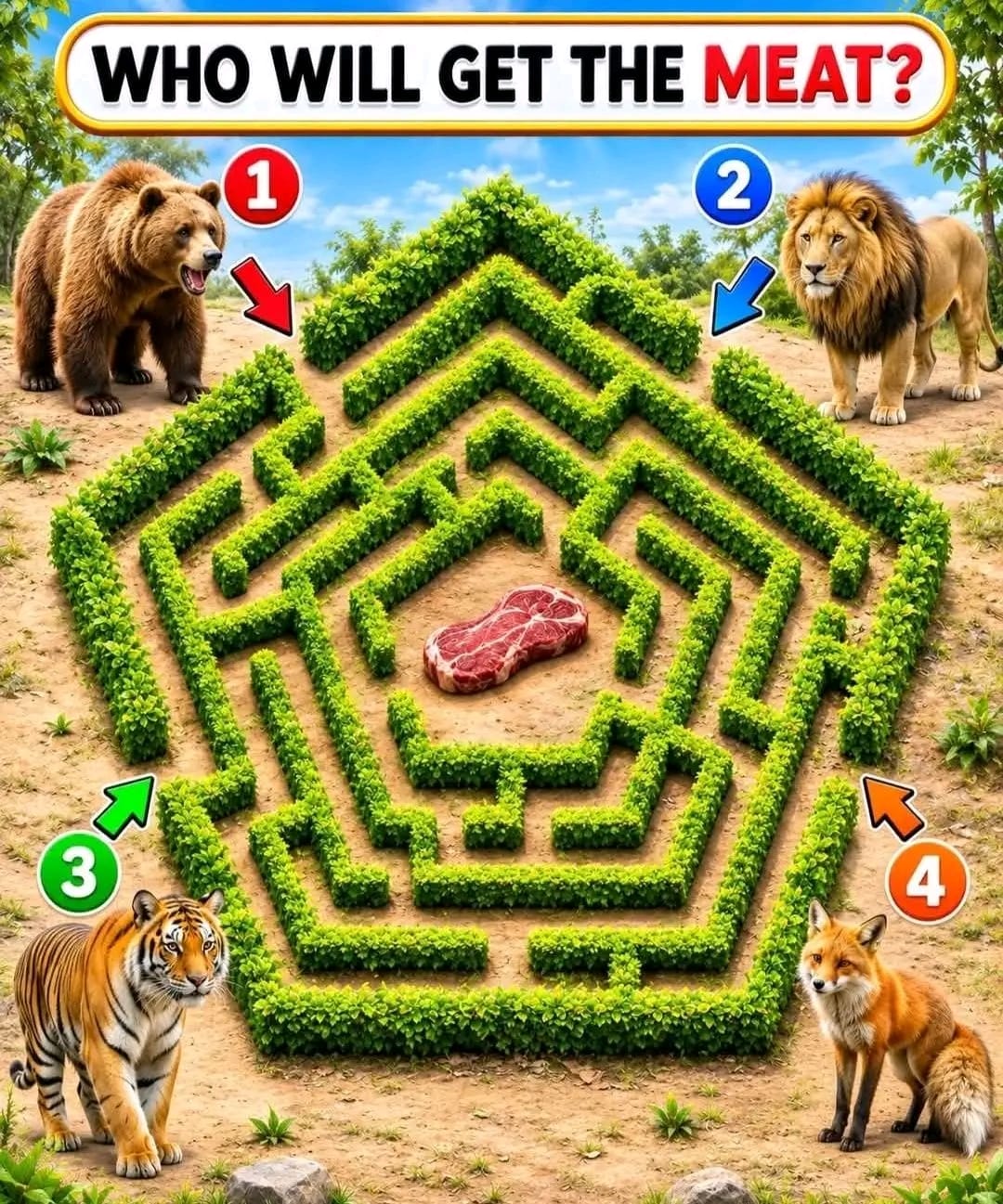
Visual puzzles, maze tracing, and brain teasers have captivated human attention for generations. Whether found in the Sunday morning newspaper, shared across social media feeds, or used as cognitive exercises for children and adults alike, these challenges test our observational skills, spatial reasoning, and visual tracking abilities. When presented with an intricate maze featuring four fierce predators—a bear, a lion, a tiger, and a fox—competing to reach a delicious piece of meat in the center, solvers are instantly drawn into the challenge of tracing the correct path among multiple confusing options.
Engaging with visual puzzles goes far beyond simple entertainment; it stimulates neural pathways, enhances problem-solving agility, and offers a refreshing mental break from daily routines. Just as individuals carefully evaluate financial investments, navigate complex legal services, or plan household improvements to protect their long-term well-being, exercising the brain with logic puzzles keeps cognitive faculties sharp. In this comprehensive guide, we examine the mechanics of visual mazes, explore the cognitive benefits of brain teasers, and reveal the exact solution to the maze puzzle.
Decoding Visual Mazes: The Science of Spatial Tracking
Why do our brains find visual tracing puzzles so engaging and yet sometimes deceptively difficult? The answer lies in how the human visual cortex processes spatial relationships and continuous lines.
1. Visual Tracking and Eye Movement
When tracing a line or a path through a complex geometric maze, your eyes rely on saccadic movements—rapid, jumpy shifts of focus from one point of interest to another.
-
The Overload Factor: When multiple overlapping paths intersect, the brain’s working memory can easily become overwhelmed, causing solvers to accidentally jump tracks from one corridor to another.
-
Working Memory Limits: Human working memory holds only a limited amount of visual data at once, which is why tracing backward from the destination (the meat in the center) is often much more effective than tracing forward from the starting points (1, 2, 3, and 4).
2. Tracing the Solution: Step-by-Step Analysis
To solve the puzzle correctly, let us trace the path backward from the central piece of meat outward:
-
Step 1: Start at the central meat and follow the open corridor outward.
-
Step 2: Notice which animal’s starting entrance remains completely open and uninterrupted by dead ends or blocked hedges.
-
Conclusion: Tracing the clear, unbroken path leads directly to animal 3 (the tiger)!
Practical Tips for Solving Visual Puzzles Faster
Sharpening your puzzle-solving skills requires practice and the implementation of strategic visual techniques:
-
Work Backward: Whenever a maze puzzle has multiple starting points converging on a single goal, start your pencil or finger at the destination and trace backward to the beginning. This eliminates false paths immediately.
-
Use a Visual Anchor: Keep your focus steady and use your finger or a digital cursor to anchor your position as you navigate intersecting pathways.
-
Take Micro-Breaks: If your eyes start playing tricks on you and paths begin to blur, look away for thirty seconds to reset your visual focus before trying again.
Interesting Facts About Brain Teasers and Cognitive Health
-
Ancient Origins: Visual puzzles and logic riddles date back thousands of years. The ancient Greeks and Egyptians used complex word and image riddles to test wisdom and problem-solving capabilities.
-
Neuroplasticity: Engaging in regular brain teasers, puzzles, and spatial reasoning games stimulates neuroplasticity—the brain’s ability to form new neural connections and maintain cognitive flexibility as we age.
-
Stress Reduction: Concentrating on a fun, low-stakes visual puzzle acts as a form of active meditation, lowering cortisol levels and distracting the mind from everyday stressors.
Conclusion
Visual puzzles like finding the correct path to the meat combine challenge, nostalgia, and cognitive stimulation into a single entertaining activity. Whether you solved it in seconds or had to trace it a few times, brain teasers provide a wonderful mental workout. By incorporating regular cognitive exercises into your routine, you keep your mind sharp while having fun along the way.
FAQ Section
Why is working backward often easier in maze puzzles?
Starting at the destination and tracing backward reduces the number of branching choices you have to test, because dead ends become immediately obvious when approached in reverse.
Do brain teasers actually improve cognitive function?
Yes. Regular engagement in visual and logic puzzles helps maintain working memory, enhances spatial reasoning, and supports lifelong cognitive health by encouraging neuroplasticity.
Which animal successfully reaches the meat in this puzzle?
Tracing backward from the center reveals that the path leading to animal 3 is the only one completely open and free of dead ends.
