
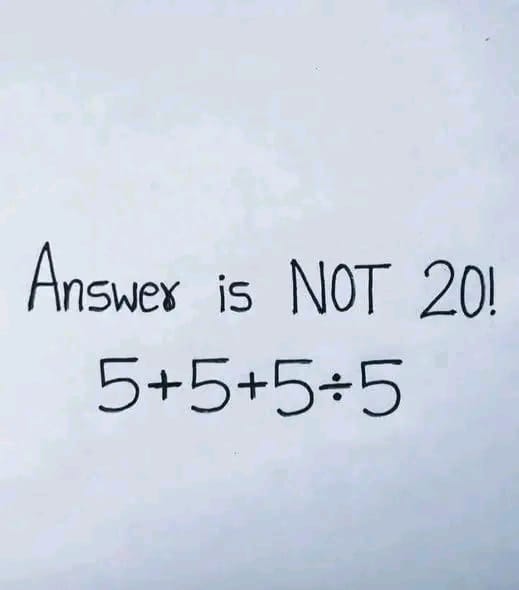
Mathematical puzzles, brain teasers, and viral social media challenges frequently capture online attention. When an image circulates with the hook “Answer is NOT 20! 5+5+5÷5”, it instantly sparks passionate mathematical debates, confusion, and thousands of comments.
While online math quizzes are designed for lighthearted entertainment and engagement, examining how mathematical rules and order of operations function provides fascinating insights into logical reasoning. In this comprehensive guide, we explore the science of order of operations, the evolution of viral math puzzles, and practical tips for critical thinking.
The Role of Order of Operations in Mathematical Puzzles
Why do simple arithmetic problems generate such widespread disagreement and engagement online? Several key factors influence how people solve these equations:
1. Understanding PEMDAS / BODMAS
-
The order of operations requires that division and multiplication be performed before addition and subtraction.
-
In the expression $5 + 5 + 5 \div 5$, the division portion ($5 \div 5$) is calculated first, resulting in $1$, which makes the full equation $5 + 5 + 1 = 11$.
2. Spotting Common Miscalculations
-
Many people mistakenly calculate equations strictly from left to right ($5 + 5 = 10$, plus $5 = 15$, divided by $5 = 3$), leading to common errors.
-
Viral math posts intentionally leverage these common order-of-operation mistakes to encourage users to comment and defend their answers.
3. The Psychology of Online Arguments
-
Prompts that challenge conventional assumptions trigger strong reactions, encouraging users to jump into the comments to prove their mathematical prowess.
Practical Tips for Critical Thinking and Mental Agility
Sharpening your problem-solving skills and engaging with brain teasers involves simple, effective habits:
-
Review Basic Rules: Always double-check standard mathematical rules like order of operations before solving complex equations.
-
Practice Mental Math: Regularly engage in puzzles and riddles to keep your mind sharp and agile.
-
Protect Your Health with Proper Insurance: Ensuring you have reliable health and life insurance coverage guarantees peace of mind and access to professional medical care in all aspects of life.
-
Verify Online Trends: Approach viral math challenges with a curious perspective, recognizing that engaging content is often optimized for community interaction.
Interesting Facts About Math Puzzles and Digital Culture
-
The History of Order of Operations: Standardized mathematical conventions were established centuries ago to ensure universal clarity and agreement in scientific and financial calculations.
-
Viral Math Engagement: Arithmetic puzzles consistently achieve massive reach on social media because everyone feels confident in their basic math skills.
-
Cognitive Bias in Visuals: When people see a bold claim like “Answer is NOT 20!”, it subconsciously guides them to look closer and re-evaluate their initial assumptions.
Conclusion
While viral internet posts debating math solutions provide fun entertainment, exploring logical reasoning and mathematical rules keeps your mind sharp. By balancing playful puzzles with proper health precautions and critical thinking, you can enjoy an informed and vibrant lifestyle.
Frequently Asked Questions (FAQ)
1. What is the correct answer to 5 + 5 + 5 ÷ 5?
The correct answer is 11, because division is performed first ($5 \div 5 = 1$), followed by addition ($5 + 5 + 1 = 11$).
2. Why do so many people get math puzzles wrong online?
Many viewers calculate expressions strictly from left to right instead of following standard order of operations rules.
3. Why are math brain teasers so popular on social media?
They are quick to read, highly relatable, and spark friendly debates in the comments section, boosting algorithmic reach.
