
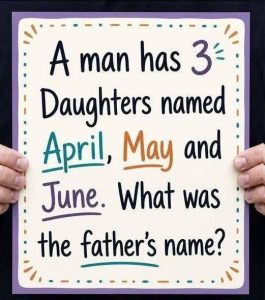
Word riddles and trick questions have long been a favorite online phenomenon. One popular riddle circulating across social media shows an image reading: “A man has 3 daughters named April, May, and June. What was the father’s name?”
While at first glance this prompt seems like a straightforward trivia puzzle or word-association riddle, it relies entirely on subtle linguistic tricks and phrasing ambiguity.
This guide breaks down the correct answer to the riddle, the psychology behind wordplay traps, and practical cognitive benefits of solving puzzles.
The Answer to the Riddle Explained
Depending on how the text is punctuated or interpreted, there are two primary ways people approach this riddle:
1. “What” is the Father’s Name
In classic versions of this linguistic trick, the riddle is framed not as a question, but as a statement: “What was the father’s name.” In this phrasing, the word “What” serves as the father’s actual name.
2. A Statement Without Explicit Information
If interpreted as a standard question, the text provided in the image gives no direct factual clues to reveal a traditional male name (like John or Robert). It simply states that he has three daughters named after consecutive months of the year. Therefore, without the statement-play trick, the father’s name is simply unspecified.
Why Brain Teasers and Riddles Engage the Mind
Linguistic puzzles leverage specific cognitive tendencies to trick the brain:
-
Pattern Recognition: Human brains naturally seek patterns. When presented with “April, May, and June,” readers automatically expect the next clue to follow a month-based pattern (such as “July”).
-
Assumed Syntax: Readers automatically add a question mark to the sentence “What was the father’s name,” overlooking the possibility that it is a declarative sentence stating his name is “What.”
Health, Insurance, and Financial Management
Engaging in mental exercises, cognitive care, and overall wellness links directly to broad household planning and financial security.
Brain Health and Insurance Coverage
Keeping the mind active through puzzles and cognitive challenges supports long-term mental sharpness:
-
Neurological and Cognitive Care: Comprehensive health and medical insurance policies cover neurological assessments, cognitive screenings, and preventive mental health visits as individuals age.
-
Preventive Health Plans: Standard health insurance plans cover routine checkups to monitor conditions that affect brain function, such as hypertension or Vitamin B12 deficiencies.
Financial Management and Future Planning
Maintaining strong cognitive health empowers individuals to make sound financial decisions. Effective personal finance management supports long-term investment portfolios, emergency funds, and retirement savings goals. For major life purchases or unexpected family costs, maintaining clear budget planning reduces reliance on a high-interest personal loan.
Consumer Rights and Legal Protections
When participating in online games, digital subscriptions, or quiz apps, data privacy laws protect personal information. If digital platforms misuse consumer data or engage in deceptive billing practices, consulting a consumer rights attorney clarifies available legal remedies.
Tips for Improving Cognitive Agility
-
Solve Daily Puzzles: Challenge your brain with crosswords, riddles, or logic puzzles to build cognitive flexibility.
-
Learn New Skills: Engaging in new hobbies or learning a language stimulates neural plasticity.
-
Stay Physically Active: Regular aerobic exercise boosts blood flow to the brain, supporting memory and problem-solving skills.
Conclusion: The Fun of Wordplay
Riddles like the “April, May, and June” puzzle highlight how easily language can play tricks on our assumptions. Whether enjoyed as a quick mental warmup or shared with friends, word games provide entertaining ways to keep our minds sharp.
Frequently Asked Questions (FAQ)
1. What is the trick behind the “April, May, and June” riddle?
The trick relies on phrasing: “What” is written as a statement rather than a question, implying the father’s name is literally “What.”
2. Are riddles good for brain health?
Yes. Solving riddles stimulates problem-solving, enhances pattern recognition, and promotes cognitive flexibility.
3. Does health insurance cover cognitive evaluations?
Yes. Standard medical insurance plans generally cover diagnostic cognitive testing and neurological consultations when recommended by a physician.
4. Why do people assume the fourth month is the answer?
The human brain naturally searches for sequential patterns, leading readers to expect “July” even though the prompt asks for the father’s name.
5. How can I keep my memory and mind sharp as I age?
Combine mental challenges like puzzles with regular physical exercise, balanced nutrition, quality sleep, and routine medical checkups.
