
Visual puzzles and optical illusions have captivated audiences for over a century. From classic newspaper brain teasers to viral social media challenges, testing your observation skills against cleverly hidden images offers an engaging way to sharpen focus and cognitive agility.
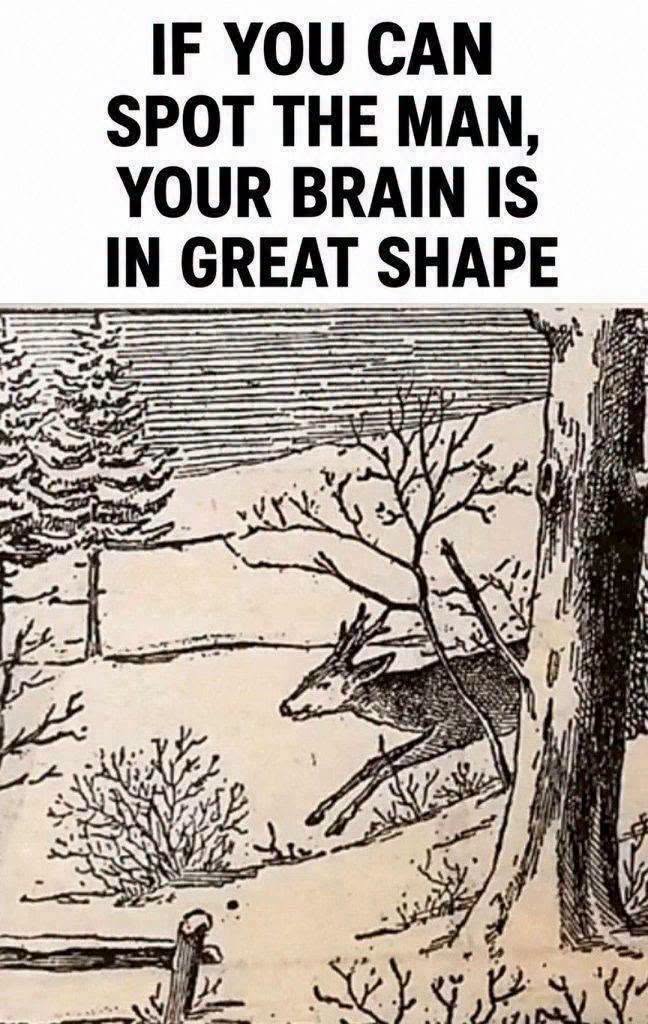
In this vintage illustration, a deer is seen leaping through a snowy forest landscape past bare trees and thick pine branches. However, tucked cleverly within the negative space and line work is the hidden face of a hunter tracking his prey.
This guide explains how optical illusions test cognitive perception, reveals the exact solution to this visual puzzle, and explores why visual brain teasers remain so popular online.
How Visual Perception and Optical Illusions Work
Our brains are naturally wired to process visual scenes by recognizing patterns and organizing complex lines into familiar objects—a psychological concept known as Pareidolia and Gestalt principles.
                   COGNITIVE ILLUSION PROCESSING
                                 │
      ┌──────────────────────────┴──────────────────────────┐
      ▼                                                     ▼
FIGURE-GROUND PERCEPTION                                PATTERN RECOGNITION
• Brain separates main subject                         • Brain fills in visual gaps to
  (deer/tree) from background                            identify hidden shapes (human face)
1. Figure-Ground Perception
When looking at an image, your visual cortex immediately attempts to isolate the main subject (the foreground figure) from the background. In this illusion, the bold lines of the deer and foreground tree draw primary focus, concealing secondary visual elements disguised within the background shading.
2. Disguised Contours and Negative Space
Artists create hidden image illusions by blending human facial features into natural contours—using tree branches to form eyebrows, bark textures for facial lines, and negative space to define eyes and noses.
Solution: Where is the Hidden Man?
If you are struggling to spot the hidden hunter, follow these visual clues to locate him in the scene:
                    STEP-BY-STEP SOLUTION CLUES
                                 │
      ┌──────────────────────────┴──────────────────────────┐
      ▼                                                     ▼
LOOK NEAR THE FOREGROUND TREE                       ROTATE OR SCAN NEGATIVE SPACE
• Focus on the large tree trunk                     • Look between the branches & deer
  on the far right side                               Antlers & branches trace the face
-
Focus on the Large Tree Trunk: Direct your attention to the large tree trunk standing on the right side of the illustration.
-
Examine the Negative Space Between Branches: Look closely at the bare tree branches extending from the center toward the right tree trunk, directly above the leaping deer.
-
Outline the Profile: The negative space framed between the branches and the tree trunk forms the side profile of a man’s face (a hunter), with tree bark creating his hat and facial features looking toward the left.
Comparing Visual Puzzle Types
Review the table below to see how different visual brain teasers challenge your cognitive processing.
| Puzzle Style | Primary Cognitive Skill | Key Challenge Mechanism |
| Hidden Face Illusions | Pattern recognition & figure-ground isolation | Disguising shapes in negative space |
| Find the Difference | Visual memory & attention to detail | Minute alterations between twin images |
| Camouflage Puzzles | Color differentiation & edge detection | Blending subjects into complex backgrounds |
| Stereograms (3D Images) | Binocular depth perception | Hiding 3D depth within 2D noise patterns |
The Cognitive Benefits of Daily Brain Teasers
Engaging with optical illusions and visual puzzles isn’t just entertainment—it actively stimulates neural pathways:
-
Enhances Attention to Detail: Scanning complex line drawings trains your visual cortex to look beyond surface-level subjects.
-
Boosts Problem-Solving Agility: Trying different visual perspectives (like tilting your head or adjusting focus) fosters cognitive flexibility.
-
Encourages Mindfulness: Taking a moment to solve a visual puzzle offers a quick, focused mental break from daily digital fatigue.
Conclusion: Test Your Vision and Keep Training Your Mind
Classic optical illusions prove that there is often far more to an image than meets the eye at first glance. Whether you spotted the hidden man in five seconds or needed a step-by-step hint, practicing visual puzzles regularly is a fun, effective way to keep your mind sharp and engaged.
Frequently Asked Questions (FAQ)
1. Why are some hidden image illusions easier for certain people to solve?
Individuals process visual data differently depending on cognitive styles. People who excel at field-independent perception can easily isolate individual components from a complex background, making hidden face puzzles easier to spot.
2. Does solving optical illusions actually improve brain health?
While visual puzzles aren’t a medical cure for cognitive decline, regular mental stimulation—including puzzles, brain teasers, and reading—helps promote cognitive reserve and keeps neural processing sharp.
3. What is pareidolia in optical illusions?
Pareidolia is the natural human tendency to perceive meaningful images (especially human faces) in random visual patterns, such as seeing faces in cloud formations, rock textures, or tree branches.
4. How can I train my eyes to spot hidden visual elements faster?
Start by scanning the image systematically in grids rather than looking at the center. Soften your visual focus to analyze negative space between objects rather than focusing solely on highlighted subjects.
