
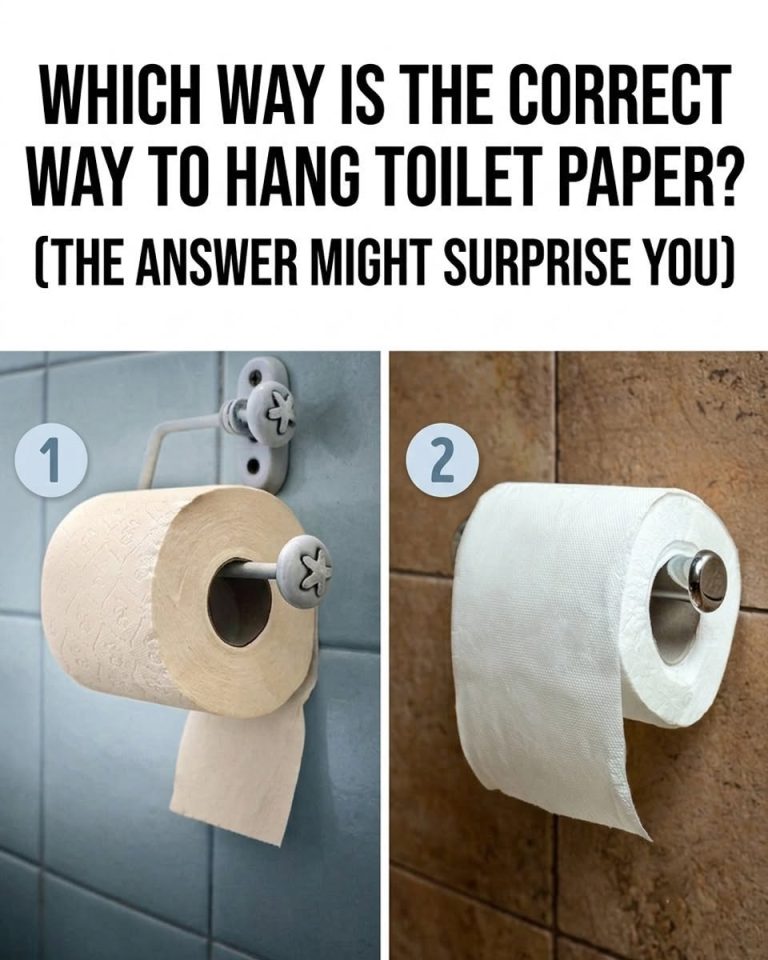
It is one of the most persistent, heated debates in household history: should the toilet paper roll hang “over” (with the loose end hanging over the front) or “under” (with the loose end hanging down against the wall)? While it might seem like a matter of personal preference, there is actually a definitive, historically documented, and scientifically backed answer.
In this guide, we dive into the original 1891 patent, examine hygiene considerations, look at common exceptions, and break down why this daily debate captures so much attention.
The Definitive Historical Answer: The 1891 Patent
The debate was officially settled on September 15, 1891, when inventor Seth Wheeler filed the original patent for perforated toilet paper rolls (U.S. Patent No. 459,516).
-
The Patent Diagrams: The official illustrations accompanying the patent clearly depict the toilet paper roll hanging in the “over” position (Option 2).
-
The Intended Design: Hanging the roll with the paper dispensing over the top allows the loose end to hang freely away from the wall, making it easier to grab, pull, and tear along the manufactured perforations.
Practical and Hygienic Arguments for “Over” (Option 2)
Beyond original historical intent, several practical and medical reasons support the “over” orientation:
1. Superior Hygiene and Germ Prevention
-
Reduced Wall Contact: When paper hangs over the front, your fingers touch only the sheet you are tearing off.
-
Fewer Bacteria Transfer: In the “under” position, hands frequently brush against the bathroom wall or tile, potentially picking up or leaving behind harmful bacteria and germs.
2. Ease of Use and Visual Convenience
-
Easier Grabbing: The loose edge is clearly visible and accessible, eliminating the need to search or feel around behind the roll.
-
Cleaner Tear: Pulling the paper forward creates optimal tension against tension-bar holders for a clean tear along the perforated line.
3. Displaying Patterns
-
Many premium toilet paper brands print decorative patterns or embossed textures on the outer surface, which are only properly visible when hung in the “over” orientation.
The Case for “Under” (Option 1): When Is It Useful?
While “over” is the clear winner for most households, there are a few practical scenarios where hanging the roll in the “under” orientation (Option 1) makes sense:
-
Pet Protection: Curious cats or dogs who like to paw at the toilet paper roll will rapidly unspool the entire roll if it is hung “over.” When placed in the “under” position, pulling down simply spins the roll harmlessly without unwinding it onto the floor.
-
Toddler Proofing: Similar to pets, young children learning to use the bathroom are less likely to accidentally unroll a full roll when it hangs under.
-
RV and Boat Travel: In moving vehicles, recreational vehicles (RVs), or boats, the “under” orientation provides slightly more friction against the wall, preventing momentum from accidentally unrolling the paper during motion.
Breakdown: “Over” vs. “Under”
| Feature | Option 2: Over (Front) | Option 1: Under (Back) |
| 1891 Patent Design | Yes | No |
| Hygiene / Less Wall Contact | Superior | Poor |
| Ease of Finding the Edge | Very Easy | Harder |
| Pet & Toddler Resistance | Low | High |
| Ideal For | Standard Bathrooms | Homes with pets/toddlers, RVs |
Frequently Asked Questions (FAQ)
What does Seth Wheeler’s patent prove?
Seth Wheeler, the inventor of perforated toilet paper, explicitly illustrated the paper hanging off the front (over) in his 1891 patent filing, proving the original design intent.
Is one way cleaner than the other?
Yes. The “over” position is generally considered more hygienic because users are far less likely to touch the wall behind the roll with dirty hands.
Why do some people prefer the “under” position?
People usually prefer “under” to stop pets or small children from unspooling the entire roll onto the floor, or simply out of habit.
Conclusion
According to history, hygiene experts, and the original inventor, Option 2 (“Over”) is officially the correct way to hang toilet paper. Unless you have a mischievous cat or toddler at home, flipping your roll to feed over the top is the cleanest and most efficient choice.
Scroll down to explore more related articles.
