
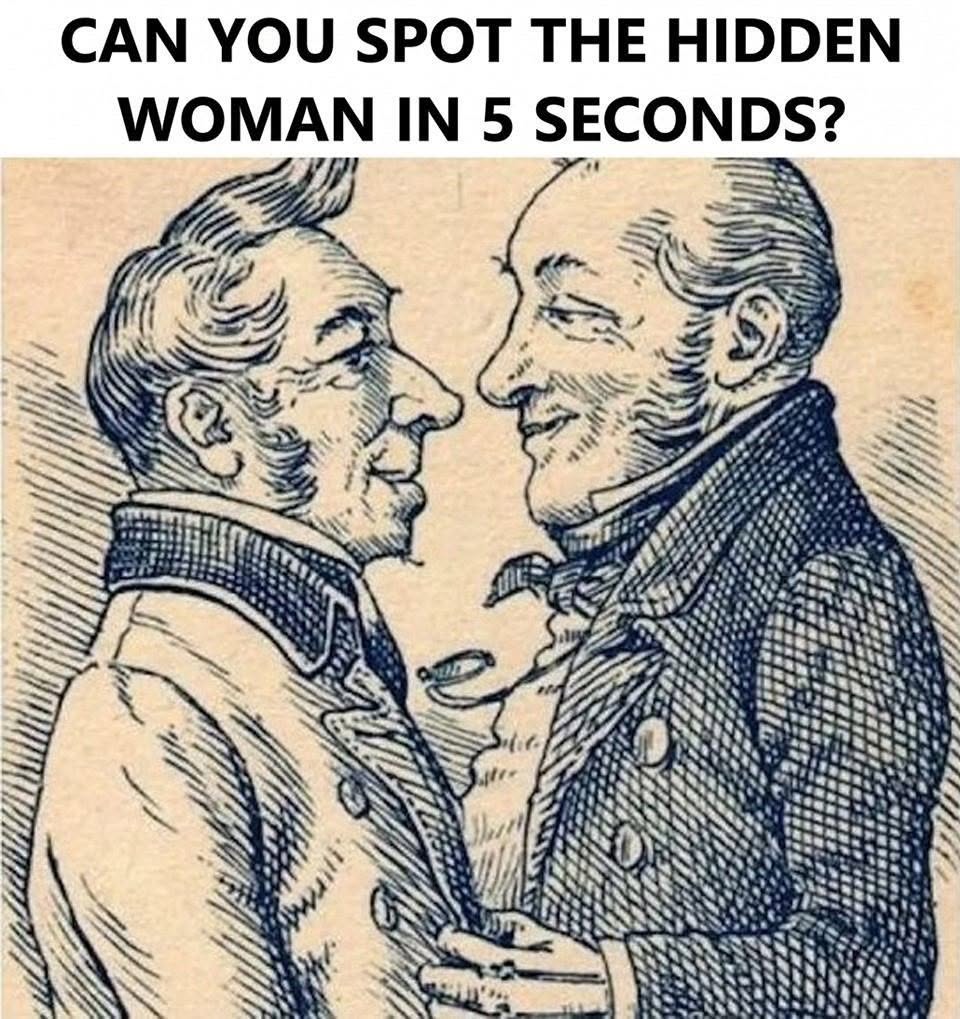
Visual brain teasers and vintage optical illusions continue to captivate internet users worldwide. These clever illustrations push our observation skills to the limit by disguising figures within negative space, shading, and dual-perception linework.
In this classic vintage drawing, two gentlemen stand facing each other in conversation. While your eyes immediately register the two men in profile, a third figure—a hidden woman—is cleverly integrated into the center of the artwork.
This guide explores the cognitive science behind dual-image illusions, provides the step-by-step solution to reveal the hidden woman, and offers practical tips for sharpening your visual observation skills.
The Visual Science Behind Negative Space Illusions
Puzzles like this rely on fundamental principles of human visual processing, specifically how the visual cortex handles contrast, negative space, and figure-ground organization.
                  VISUAL PERCEPTION MECHANISMS
                                │
      ┌─────────────────────────┴─────────────────────────┐
      ▼                                                   ▼
FIGURE-GROUND REVERSAL                                PAREIDOLIA & CONTOUR BINDING
• Brain shifts focus from primary                   • Brain connects separate lines
  figures (men) to empty middle space                 to form a complete human silhouette
1. Figure-Ground Reversal
When viewing an image, your brain instantly determines what is the subject (figure) and what is the background (ground). In this drawing, the two men act as the foreground figures. To spot the hidden woman, you must shift your focus to the negative space between them.
2. Line Integration and Contour Sharing
Artists construct optical illusions by using shared contours. The facial profiles, collars, and jackets of the two men double as the outer silhouette, hair, and dress of the hidden female figure.
Solution: Where is the Hidden Woman?
If you haven’t spotted her yet, follow these simple steps to reveal the hidden image:
                  STEP-BY-STEP SOLUTION CLUES
                                │
      ┌─────────────────────────┴─────────────────────────┐
      ▼                                                   ▼
FOCUS ON THE CENTER GAP                             OUTLINE THE SILHOUETTE
• Look directly between the faces                  • Man on left forms her back/head
  of the two gentlemen                               Man on right forms her front/skirt
-
Look at the Space Between the Men: Direct your gaze precisely to the central space where the two men face each other.
-
Observe the Negative Space: The negative space framed between their two bodies forms the full silhouette of a woman standing in profile or full figure.
-
Trace the Outlines:
-
The chin, nose, and jacket of the man on the left outline the back and head of the woman.
-
The forehead, nose, and coat of the man on the right define her front and dress line.
-
The space between their collars forms her head and hair.
-
Comparing Types of Visual Illusions
Understanding how different optical illusions trick the eye can help you solve them faster:
| Illusion Type | How It Tricks the Eye | Primary Focus Area |
| Negative Space Illusions | Conceals figures in empty space between subjects | Background gaps and borders |
| Ambiguous Figures | Single image can be interpreted in two distinct ways | Dual-purpose line art |
| Camouflage Puzzles | Matches subject color and texture to background | Edge detection and texture breaks |
| Perspective Tricks | Uses forced angles to warp size and depth | Distance and horizon lines |
Practical Benefits of Solving Visual Brain Teasers
Engaging with visual puzzles regularly offers several mental benefits:
-
Improves Visual Scanning: Exercises your ability to systematically analyze images rather than relying on quick visual assumptions.
-
Enhances Focus and Concentration: Trains your mind to tune out primary distractions to locate subtle details.
-
Encourages Cognitive Flexibility: Helps your brain switch rapidly between different visual perspectives and interpretations.
Conclusion: Train Your Brain to See Beyond the Surface
Visual puzzles are a reminder that first impressions don’t always tell the whole story. By shifting your perspective and focusing on the negative space, hidden details instantly come into view.
Share this puzzle with friends and family to see who can spot the hidden woman in under 5 seconds!
Frequently Asked Questions (FAQ)
1. Why couldn’t I see the hidden woman at first glance?
Your brain automatically prioritizes high-contrast, recognizable primary figures—in this case, the detailed faces of the two men. It takes intentional cognitive effort to shift focus away from primary figures toward the empty space between them.
2. Are visual puzzles good for cognitive health?
Yes! Regularly challenging your brain with puzzles, optical illusions, and observational tasks helps stimulate mental activity, supports problem-solving skills, and maintains cognitive sharpness.
3. What is figure-ground perception?
Figure-ground perception is the visual system’s ability to simplify a scene into the main object being looked at (the figure) and the surrounding environment (the ground).
4. How can I solve negative space illusions faster?
Try softening your focus on the main subjects, blurring your vision slightly, or looking exclusively at the white space or background areas where shapes frequently hide.
