
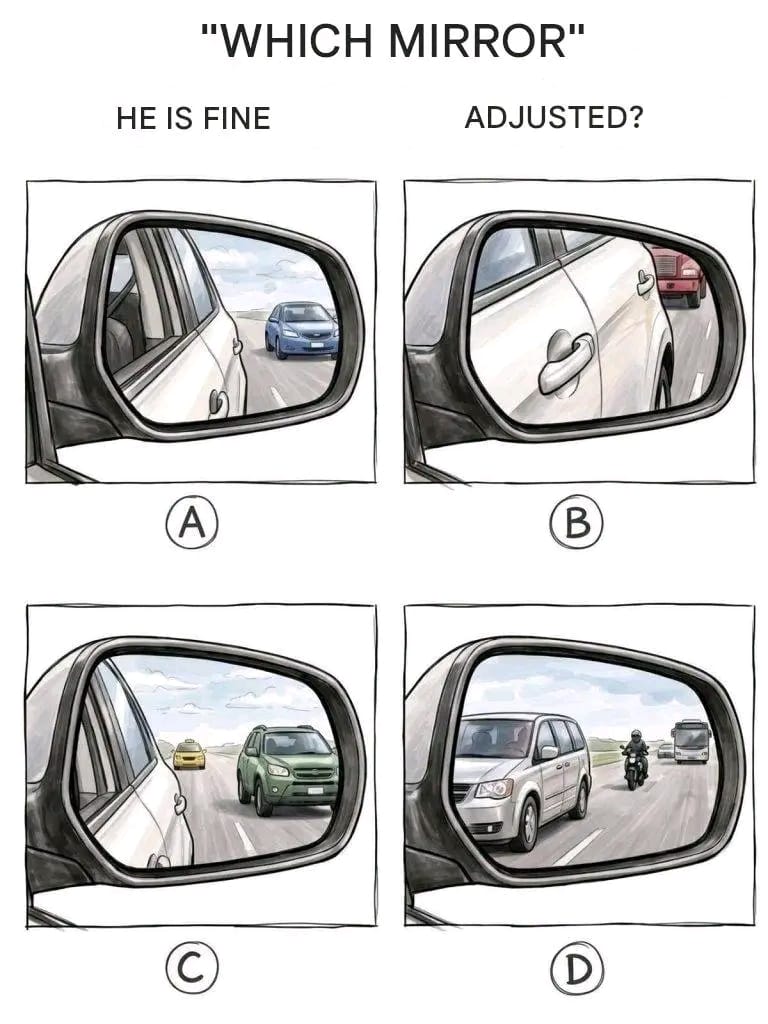
Driving safety depends heavily on clear visibility, quick decision-making, and proper vehicle maintenance. Across social media platforms, instructional driving graphics frequently ignite intense debates among motorists, such as posts asking “Which Mirror Is Fine Adjusted?” while presenting different side mirror viewing angles labeled A, B, C, and D.
While millions of drivers learn traditional mirror positioning during their initial driver’s education, automotive safety experts and organizations like the Society of Automotive Engineers (SAE) recommend modern adjustment methods designed to eliminate dangerous blind spots. In this comprehensive guide, we explore the science of side mirror alignment, safe driving techniques, and practical steps to maintain road safety and vehicle security.
The Science of Correct Side Mirror Adjustment
Why do conventional mirror positions often leave dangerous gaps in visibility, and how can drivers fix them? Understanding visual angles helps explain proper vehicle setup:
1. The Traditional vs. BGE (Blind Spot and Glare Elimination) Method
Many drivers set their side mirrors so they can see the side of their own car while sitting upright in the driver’s seat (as seen in panel A). However, this creates redundant viewing areas that overlap with the rearview mirror, leaving large blind spots along adjacent lanes. Proper adjustment pushes the side mirrors further outward so that approaching vehicles transition seamlessly from the rearview mirror directly into your side mirror reflection.
2. Identifying Incorrect Mirror Angles
-
Too Inward (Panel B): Showing too much of your own vehicle’s body panels limits your view of adjacent traffic lanes entirely.
-
Improper Height or Distance (Panels C and D): Misaligned vertical angles or incorrect convex reflections can misrepresent vehicle distance and lane positioning.
-
Optimal Setup: Adjusting your driver’s side mirror by leaning your head against the driver’s window and tilting the mirror until the edge of your car is barely visible maximizes coverage of adjacent lanes.
Practical Tips for Safe Driving and Vehicle Maintenance
Maintaining optimal safety on the road requires consistent habits, proper equipment checkups, and clear awareness:
-
Perform the Head-Lean Test: To set your left side mirror, lean your head against the driver-side window and adjust the mirror until the side of your car just barely comes into view. For the right side mirror, lean your head toward the center console to perform the same adjustment.
-
Always Check Blind Spots Manually: Even with properly adjusted mirrors, perform a quick shoulder check before changing lanes or merging onto high-speed highways.
-
Protect Your Vehicle with Proper Insurance: Securing comprehensive auto insurance coverage ensures financial protection, emergency roadside assistance, and coverage against accidents or property damage.
-
Keep Mirrors Clean and Clear: Regularly wipe down side mirrors and test heated defrost features to ensure clear visibility during rain, fog, or icy winter weather.
Interesting Facts About Vehicle Safety and Design
-
Convex vs. Flat Glass: Driver-side mirrors in North America typically feature flat glass to give accurate distance perception, while passenger-side mirrors use convex glass to provide a wider field of view.
-
The SAE Recommendation: The Society of Automotive Engineers published the BGE (Blind Spot and Glare Elimination) method in 1995 to dramatically reduce highway lane-change collisions.
-
Digital Rearview Systems: Modern luxury and electric vehicles increasingly feature digital side cameras and blind-spot monitoring systems to supplement traditional glass mirrors.
Conclusion
While online driving visual tests provoke energetic discussion among car enthusiasts, mastering proper mirror positioning is a crucial skill for every driver. By eliminating blind spots using proven adjustment methods, performing regular shoulder checks, and maintaining reliable auto insurance, you can ensure a safer, more confident journey on every drive.
Frequently Asked Questions (FAQ)
1. Which mirror position is considered correctly adjusted?
The optimal mirror setup minimizes the view of your own car’s side panels while expanding coverage of adjacent traffic lanes, preventing overlap with your center rearview mirror.
2. What is the main cause of blind-spot accidents?
Blind-spot accidents occur primarily when side mirrors are turned too far inward toward the driver’s own vehicle, leaving unmonitored zones where adjacent cars can disappear.
3. Do blind-spot monitoring sensors replace the need to adjust mirrors?
No. While electronic blind-spot sensors provide helpful alerts, proper manual mirror alignment and physical shoulder checks remain essential primary safety measures.
