
As family members and loved ones age, paying close attention to sudden shifts in physical health, coordination, and cognitive function becomes a vital responsibility. Among the most critical health events affecting older adults is a Transient Ischemic Attack (TIA), commonly known as a “mini-stroke.”
A mini-stroke occurs when blood flow to a portion of the brain is temporarily restricted or blocked by a micro-clot or vascular spasm. Unlike an acute ischemic stroke, symptoms of a mini-stroke typically resolve within minutes to a few hours, leaving no permanent neurological tissue damage.
However, medical experts emphasize that a mini-stroke is never something to ignore: it serves as a powerful, immediate clinical warning sign. Studies show that nearly 1 in 3 people who experience a TIA go on to suffer a major, life-threatening stroke, with the highest risk occurring within the first 48 hours to 30 days following the event.
In this ultimate medical, geriatric care, and health management guide, we detail the 5 major signs of a mini-stroke in elderly adults, explain the biological mechanisms behind TIAs, outline emergency response protocols, and examine how proactive health care protects your physical well-being, healthcare budget, and personal finances.
Understanding Mini-Strokes (TIA) vs. Major Strokes
To protect aging family members, it helps to understand the medical distinction between a Transient Ischemic Attack and an acute cerebrovascular event:
[ Temporary Blood Flow Interruption ] ──> TIA / Mini-Stroke ──> Symptoms Resolve (Major Warning Sign!)
[ Prolonged Arterial Blockage ]      ──> Ischemic Stroke    ──> Permanent Brain Cell Damage
What Happens During a TIA?
During a mini-stroke, a tiny blood clot or plaque buildup briefly obstructs a small artery in the brain. Because the body’s natural clot-dissolving mechanisms break down the micro-blockage quickly, blood flow is restored before brain tissue suffers permanent necrosis (cell death).
Because the symptoms disappear quickly, elderly individuals and caregivers often dismiss the episode as temporary tiredness, a mild migraine, or simple age-related clumsiness. Recognizing these fleeting symptoms is the key to preventing a catastrophic full stroke.
5 Warning Signs of Mini-Stroke in the Elderly
When observing an elderly family member or aging parent, watch closely for these 5 distinct, sudden-onset symptoms:
1. Sudden Weakness or Numbness on One Side of the Body
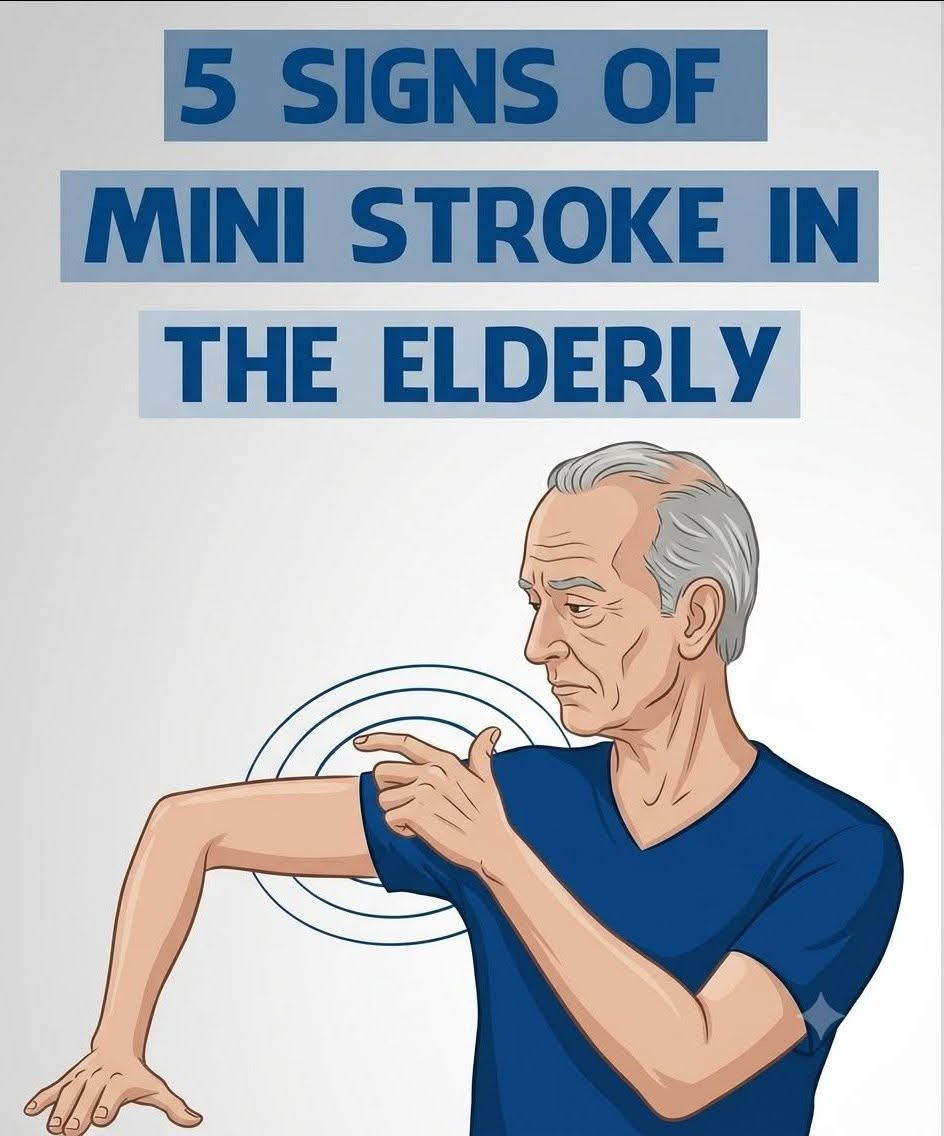
Unilateral (one-sided) physical weakness or numbness is a classic indicator of reduced cerebral blood flow. An elderly person may suddenly lose grip strength in one hand, drop a coffee cup, experience heaviness in one arm, or have one leg give out unexpectedly while walking.
2. Sudden Facial Drooping or Asymmetry
Loss of facial nerve control causes one side of the face to droop or feel numb. When asked to smile, the corner of the mouth on the affected side may remain flat or pull downward, and one eye socket may appear asymmetrical.
3. Sudden Difficulty Speaking or Understanding Speech
Temporary ischemia in the language centers of the brain (Broca’s or Wernicke’s areas) causes sudden slurring of words (dysarthria), confusion, or difficulty finding basic words (aphasia). The person may sound as though they are mumbling or struggle to comprehend simple questions.
4. Sudden Vision Loss or Distortions
A mini-stroke often affects the ophthalmic or cerebral arteries, leading to sudden, painless vision changes in one or both eyes. This can manifest as blurred vision, double vision (diplopia), or a temporary phenomenon known as amaurosis fugax—where the person describes a dark shade or curtain dropping over their field of vision for a few minutes.
5. Sudden Loss of Balance, Dizziness, or Coordination
Ischemia affecting the cerebellum or brainstem disrupts spatial orientation and motor control. The individual may experience sudden, intense dizziness (vertigo), unsteadiness on their feet, unexpected staggering, or an inability to walk in a straight line.
Clinical Comparison: TIA vs. Acute Ischemic Stroke
Understanding how mini-strokes present compared to major strokes helps caregivers act decisively:
| Diagnostic Metric | Transient Ischemic Attack (TIA) | Acute Ischemic Stroke |
| Duration of Symptoms | Minutes to a few hours (usually under 1 hour) | Persistent (Does not resolve without medical intervention) |
| Permanent Brain Damage | None visible on standard neuroimaging | Yes (Permanent tissue necrosis if untreated) |
| Primary Underlying Cause | Temporary micro-embolus or arterial spasm | Fixed blood clot (thrombus or embolus) blocking artery |
| Primary Clinical Significance | High-risk precursor to major stroke | Acute neurological emergency |
| Immediate Action | Emergency Medical Evaluation (Call 911) | Emergency Medical Evaluation (Call 911) |
The F.A.S.T. Protocol and Emergency Steps
Even if symptoms disappear after 5 or 10 minutes, always treat a suspected mini-stroke as a medical emergency. Follow the F.A.S.T. protocol immediately:
-
F — Face: Ask the person to smile. Does one side of their face droop?
-
A — Arms: Ask the person to raise both arms. Does one arm drift downward?
-
S — Speech: Ask the person to repeat a simple phrase. Is their speech slurred or strange?
-
T — Time: If you observe any of these signs, call 911 immediately! Do not wait to see if symptoms return.
Financial and Health Protections: Preventive Geriatric Care
Taking proactive steps to manage stroke risk factors delivers essential benefits for physical health, family budget management, and long-term financial security.
-
Preventing Long-Term Disability and Dependency: Preventing a major stroke through early TIA evaluation protects an elderly relative’s cognitive independence and physical mobility, preserving their quality of life and dignity.
-
Avoiding Massive Emergency Medical Expenses: Severe, disabling strokes require prolonged intensive care unit (ICU) hospital stays, inpatient rehabilitation, and round-the-clock nursing care. Treating a TIA preventatively eliminates tens of thousands of dollars in potential out-of-pocket medical costs and nursing home fees.
-
Protecting Retirement Investments and Estate Assets: Managing chronic conditions like high blood pressure (hypertension), high cholesterol, and atrial fibrillation through routine medication preserves family assets and prevents the sudden drain of retirement investment portfolios on long-term care facilities.
-
Maintaining Optimal Insurance Coverage: Keeping medical risk profiles stable through regular primary care visits helps secure affordable secondary supplemental health and long-term care insurance coverage.
Frequently Asked Questions (FAQ)
Should you take an elderly person to the hospital if mini-stroke symptoms go away completely?
Yes, absolutely! Never take a “wait and see” approach. Even if symptoms fully disappear, the underlying cause (such as an unstable blood clot or carotid artery narrowing) remains active. Immediate hospital evaluation, brain imaging (CT or MRI), and blood vessel scans are crucial to prevent a full stroke from occurring shortly after.
What are the main risk factors for mini-strokes in older adults?
The leading risk factors for TIAs in elderly adults include uncontrolled high blood pressure (hypertension), high cholesterol, diabetes, atrial fibrillation (an irregular heart rhythm that promotes blood clots), smoking, physical inactivity, and a history of cardiovascular disease.
Can a mini-stroke be diagnosed after symptoms have stopped?
Yes. Neurologists utilize specialized MRI scans (Diffusion-Weighted Imaging), carotid artery ultrasounds, echocardiograms, and continuous heart monitoring to detect subtle vascular changes and identify the precise cause of the temporary blockage.
What medications are typically prescribed after a mini-stroke?
To prevent future strokes, physicians commonly prescribe antiplatelet medications (such as aspirin or clopidogrel), anticoagulants (blood thinners for patients with atrial fibrillation), cholesterol-lowering statins, and targeted antihypertensive drugs to control blood pressure.
Final Thoughts
A mini-stroke in an elderly family member is a serious event, but recognizing the warning signs and seeking immediate emergency care provides an invaluable opportunity to prevent a major stroke!
By learning the 5 key warning signs, using the F.A.S.T. protocol, managing blood pressure, and prioritizing routine cardiovascular checkups, you can safeguard your loved one’s health, protect your family’s future, and enjoy peace of mind for years to come!
