
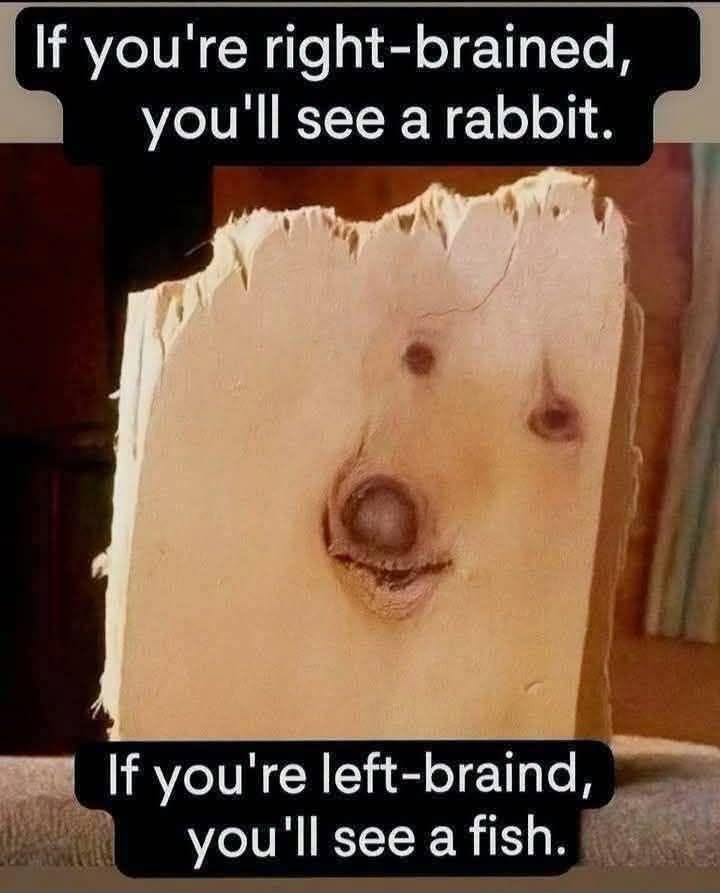
Viral visual puzzles frequently circulate online claiming that what you see in a picture reveals whether you are “left-brained” or “right-brained.” In reality, these fun optical tricks rely on a psychological phenomenon called pareidolia—the human tendency to perceive familiar patterns, particularly faces or animals, in random objects like wood grain, clouds, or food.
While the “left-brain vs. right-brain” personality concept is a popular myth, visual perception itself reveals fascinating insights into how the brain processes shapes and contours.
This guide explores the science behind pareidolia, why the brain recognizes familiar forms, and the truth about brain hemisphere dominance.
The Science of Pareidolia and Visual Processing
The human brain is an extraordinary pattern-recognition machine wired to make sense of ambiguous visual information.
                    HOW PAREIDOLIA WORKS IN THE BRAIN
                                    │
      ┌─────────────────────────────┼─────────────────────────────┐
      ▼                             ▼                             ▼
VISUAL INPUT PROCESSING         FACIAL RECOGNITION            PATTERN COMPLETION
• Eye detects knots and         • Fusiform face area          • Brain fills in gaps
  grain in a piece of wood        highlights eye/nose shapes    to form a complete animal
1. Pareidolia and Survival Evolution
From an evolutionary standpoint, recognizing faces and creatures quickly was crucial for human survival. The brain’s visual cortex and specialized regions (such as the fusiform face area) prioritize recognizing facial features—like eyes, a snout, or a mouth—even when looking at inanimate objects like a cut piece of timber.
2. The Left-Brain vs. Right-Brain Myth
Neuroscience has thoroughly debunked the idea that people are strictly “left-brained” (analytical) or “right-brained” (creative). Visual processing requires seamless, complex communication across both hemispheres of the brain via the corpus callosum, regardless of what animal or shape you spot first.
What Do You See in the Wood Grain?
Visual puzzles leverage natural contours and textures to prompt different interpretations:
| What People See | Visual Features That Trigger It | Psychological Mechanism |
| Dog / Golden Retriever | Dark knot resembles a nose; small dark spots look like eyes | Facial pareidolia (strongest response) |
| Rabbit or Fish | Outer bark contours and angled grain patterns | Gestalt shape completion & visual suggestion |
| Piece of Wood | Natural timber cuts, growth rings, and knots | Literal, detail-focused visual analysis |
3 Fun Ways Visual Puzzles Challenge Your Mind
-
Practice Mindful Observation: Pause and notice how changing your focal point or distance alters the image your brain constructs.
-
Test Context Sensitivity: Read different captions before looking at an image; verbal suggestions heavily influence what your visual system expects to see.
-
Share with Friends: Compare interpretations with family to see how individual visual biases create completely different initial impressions.
Conclusion: Celebrating How Our Brains See the World
Whether you instantly spotted a dog’s face, a rabbit, or simply a block of wood, visual illusions highlight the creative ways our minds make sense of the world around us. Rather than defining brain dominance, these puzzles serve as an entertaining reminder of human visual perception at work.
Frequently Asked Questions (FAQ)
1. Is there actually a right-brain vs. left-brain test?
No. Modern brain imaging shows that both hemispheres work together for both logical tasks and creative visual recognition. The idea that brain dominance determines personality or perception is a myth.
2. What causes people to see faces in everyday objects?
This is caused by pareidolia, a sensory phenomenon where the brain misinterprets random visual details—such as knots in wood or shapes in clouds—as familiar human or animal faces.
3. Why do visual caption prompts influence what I see?
The brain uses “top-down processing,” where expectations and reading context prime your visual system to look for specific shapes before you fully process the entire image.
