
Introduction
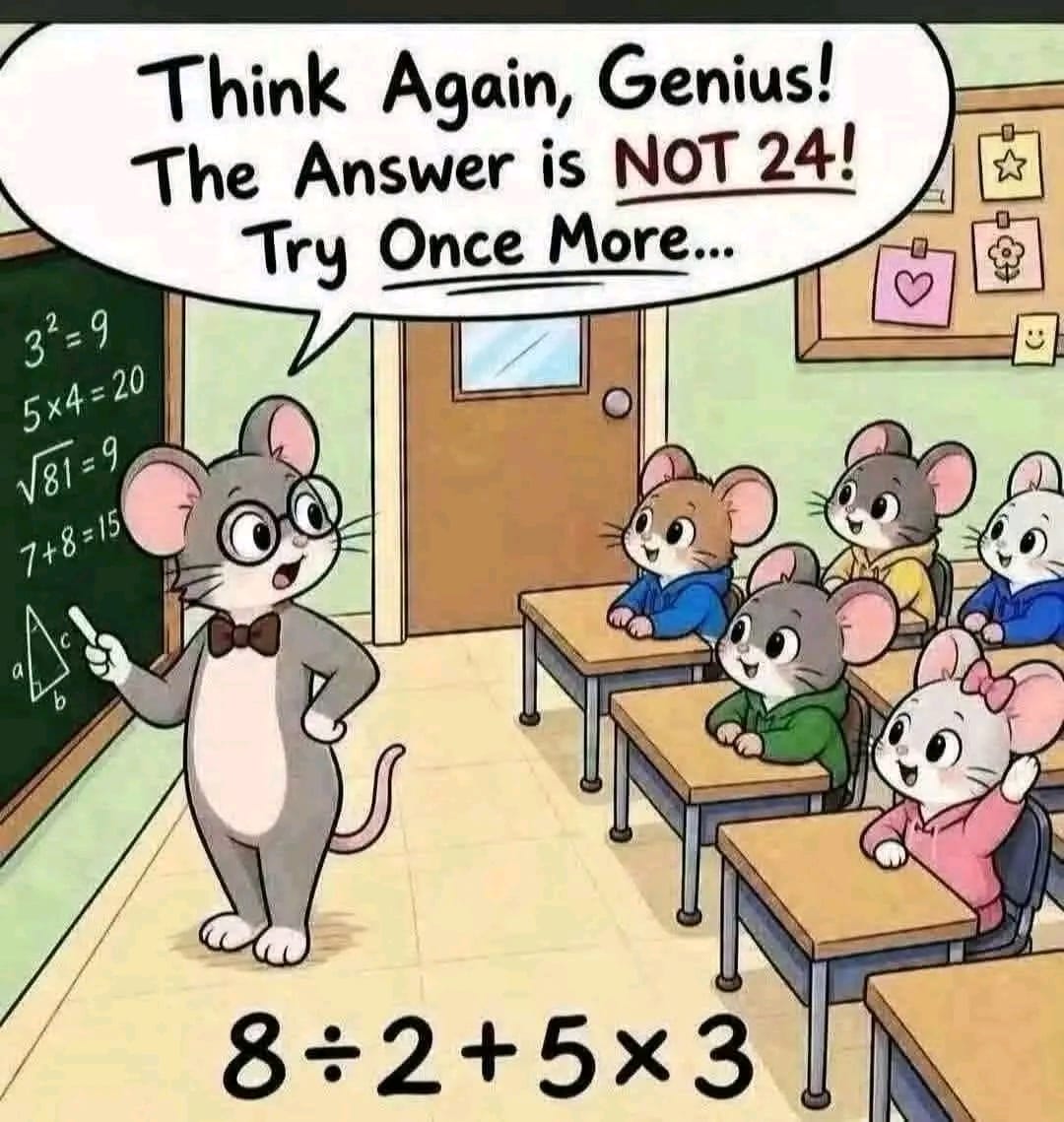
Math riddles, viral arithmetic puzzles, and order-of-operations brain teasers have captivated human attention for generations. Whether shared across social media feeds or used as fun educational challenges to test friends and family, these clever equations spark passionate debates over basic arithmetic rules. When presented with a classroom scene where a teacher mouse challenges students with the equation 8÷2+5×38 \div 2 + 5 \times 3 and notes that 24 is incorrect, solvers are instantly drawn into a lively debate on how to properly solve the problem.
Engaging with math puzzles goes far beyond simple entertainment; it stimulates cognitive agility, sharpens analytical thinking, and offers a refreshing mental break from daily routines. Just as individuals carefully evaluate financial investments, navigate complex problem-solving tasks, or plan household routines, exercising the brain with arithmetic challenges keeps cognitive faculties sharp. In this comprehensive guide, we examine the mechanics of order-of-operations rules, explore mathematical psychology, and reveal the correct solution.
Decoding Order of Operations: The Science of PEMDAS/BODMAS
Why do our brains sometimes stumble over simple arithmetic expressions, and why do these puzzles go viral online? The answer lies in how mathematical conventions govern multi-step calculations.
1. Following the Rules of Precedence
When evaluating an expression containing division, multiplication, addition, and subtraction, strict mathematical rules determine the sequence of steps.
-
Multiplication and Division First: According to standard order-of-operations rules (PEMDAS/BODMAS), multiplication and division must be calculated from left to right before addition and subtraction.
-
The Calculation: Breaking down 8÷2+5×38 \div 2 + 5 \times 3 means first solving 8÷2=48 \div 2 = 4 and 5×3=155 \times 3 = 15, and then adding those results together (4+15=194 + 15 = 19), which explains why answers like 24 are incorrect and why these posts drive massive engagement and debate across social media platforms.
Practical Tips for Solving Math Puzzles Faster
Sharpening your arithmetic skills and avoiding common pitfalls requires a systematic approach:
-
Apply PEMDAS/BODMAS Strictly: Always isolate multiplication and division operations before tackling addition and subtraction.
-
Share and Compare: Tagging friends and comparing answers sparks entertaining conversations and differing viewpoints in the comments.
-
Take Micro-Breaks: Exploring diverse logic and math puzzles provides a wonderful mental workout throughout your day.
Interesting Facts About Math Puzzles and Online Debates
-
Mathematical Conventions: Standardized order of operations was globally established to ensure that mathematical expressions yield a single, unambiguous answer regardless of who is calculating them.
-
Neuroplasticity: Engaging in regular brain teasers, visual puzzles, and math challenges stimulates neuroplasticity—the brain’s ability to form new neural connections and maintain cognitive flexibility as we age.
-
Social Media Virality: Simple arithmetic equations with common point-of-error answers tap into the human desire for community engagement and shared debate, sparking lively discussions worldwide.
Conclusion
Math puzzles like solving viral order-of-operations equations combine challenge, education, and social connection into a single entertaining activity. Whether you solved it instantly or fell into the common arithmetic trap, these brain teasers provide a wonderful mental break and a great excuse to chat with friends. By incorporating regular cognitive exercises into your routine, you keep your mind sharp while having fun along the way.
FAQ Section
Why is 24 an incorrect answer for 8÷2+5×38 \div 2 + 5 \times 3?
Calculating straight across from left to right without respecting order of operations leads to errors; multiplication and division must be performed before addition.
What is the correct step-by-step solution?
First, calculate 8÷2=48 \div 2 = 4 and 5×3=155 \times 3 = 15. Then, add the two intermediate results together: 4+15=194 + 15 = 19.
Why do math equation posts generate so many comments?
They spark intense friendly arguments between people who use strict order of operations versus those who calculate linearly, encouraging lively debate in the comments.
